How IoT Sensors Are Revolutionizing Commercial Restroom Maintenance
How IoT Sensors Are Revolutionizing Commercial Restroom Maintenance. How IoT Sensors Are Revolutionizing Commercial Restroom Maintenance Discover how
How IoT Sensors Are Revolutionizing Commercial Restroom Maintenance
Discover how smart sensors are transforming facility management with real-time monitoring, predictive alerts, and data-driven maintenance strategies.
The Hidden Cost of Traditional Restroom Maintenance
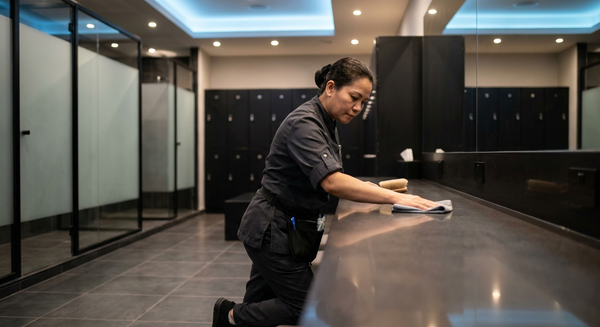
For facility managers, restrooms have always been a reactive headache. A clogged toilet, an empty soap dispenser, or a flooded floor becomes a crisis that demands immediate attention—often discovered only after a tenant or visitor files a complaint.
This reactive model comes with real costs:
- Labor inefficiency: Custodial staff spend hours on scheduled rounds, checking facilities that do not need attention while emergencies go unnoticed
- Tenant dissatisfaction: Nothing damages a buildings reputation faster than a poorly maintained restroom
- Wasted supplies: Paper towels, soap, and cleaning chemicals are often overstocked or understocked due to guesswork
- Emergency repairs: Water damage from undetected leaks can cost thousands in repairs
The traditional approach—fixed schedules and visual inspections—simply cannot keep pace with the demands of modern commercial facilities.
Enter IoT: The Smart Restroom Revolution
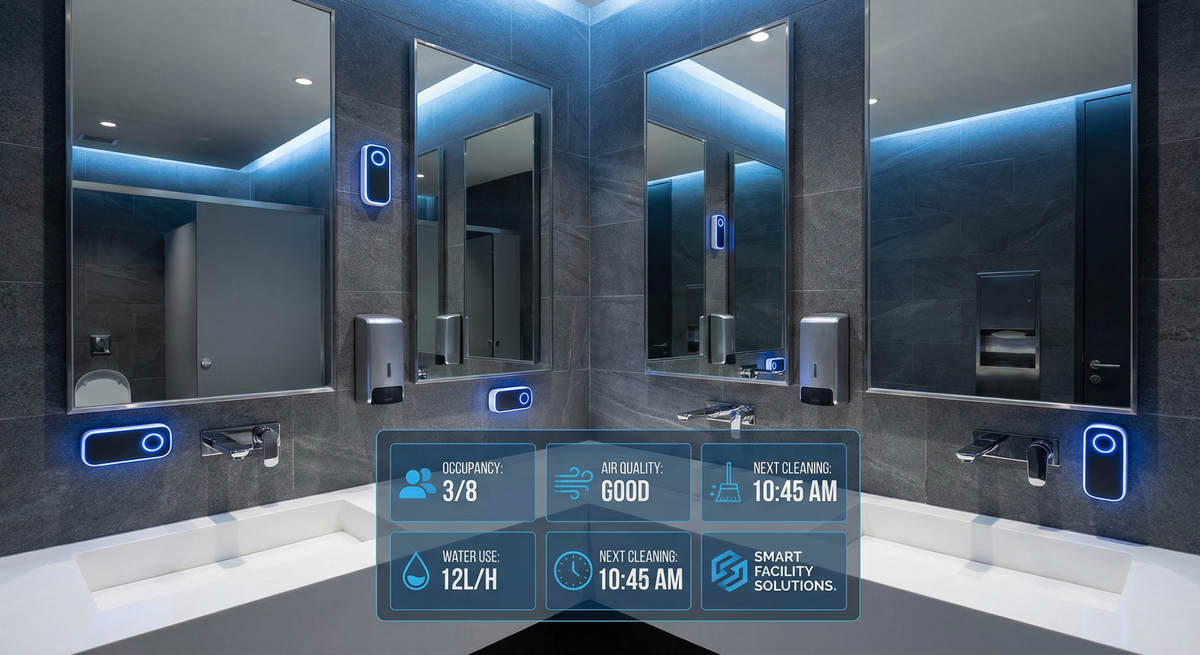
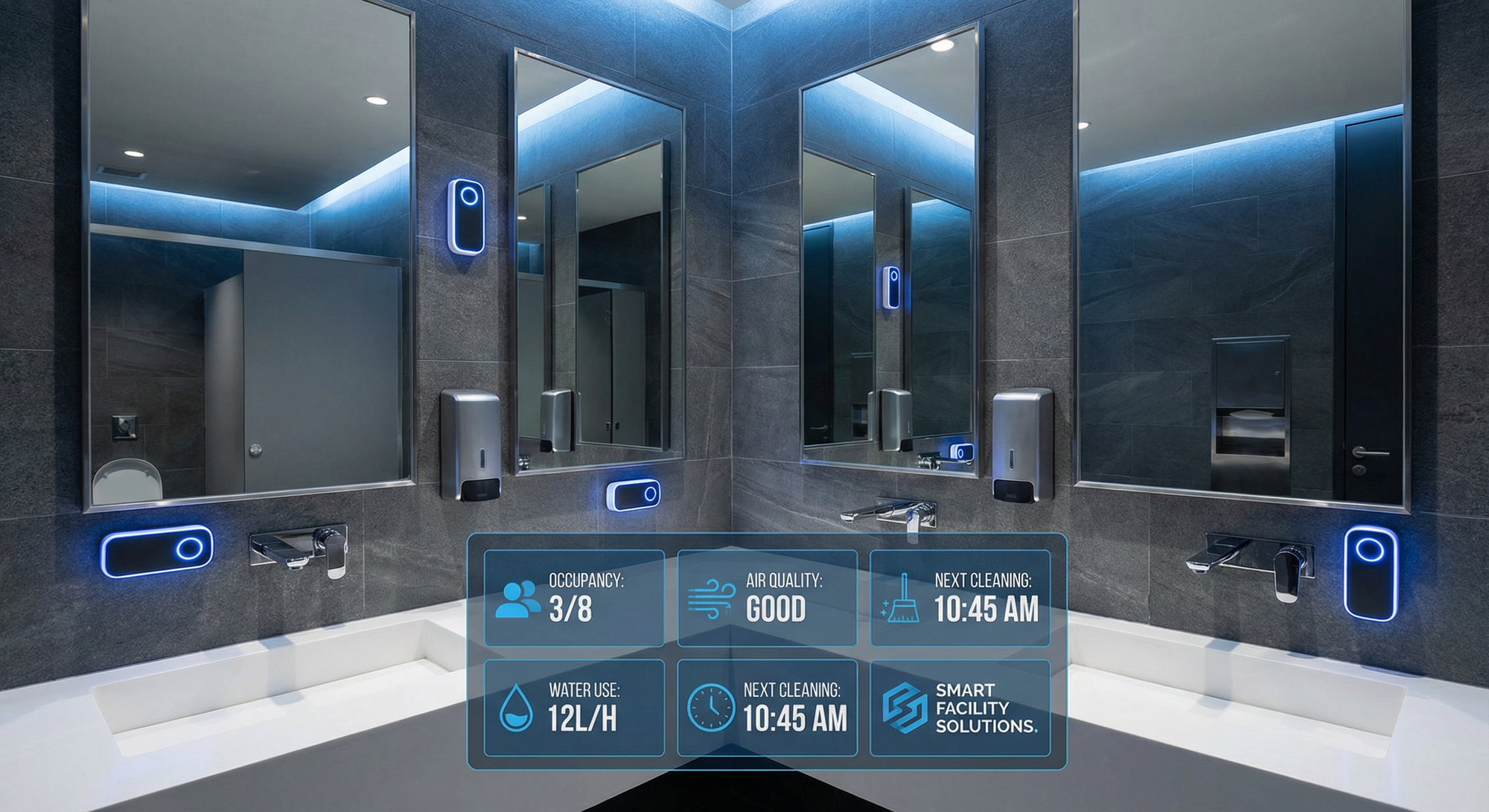
Internet of Things (IoT) sensors are fundamentally changing how facility teams approach restroom maintenance. By deploying small, wireless sensors throughout restroom facilities, building managers gain real-time visibility into conditions that were previously invisible.
What Can Smart Sensors Monitor?
Modern IoT restroom solutions track a range of critical metrics:
| Sensor Type | Function | Business Impact |
|---|---|---|
| Occupancy Sensors | Count entries and exits | Optimize cleaning schedules based on actual usage |
| Soap & Paper Dispensers | Monitor supply levels | Prevent runouts, reduce overstocking |
| Water Leak Detectors | Detect moisture immediately | Prevent water damage before it spreads |
| Air Quality Sensors | Measure VOCs, humidity, odors | Trigger ventilation or cleaning alerts |
| Toilet/Urinal Sensors | Track flush counts, detect clogs | Identify maintenance needs proactively |
| Temperature Sensors | Monitor water heater performance | Ensure compliance, reduce energy waste |
5 Ways IoT Sensors Transform Restroom Operations
1. Predictive Maintenance Instead of Reactive Fixes
Instead of waiting for a toilet to overflow or a faucet to leak, smart sensors detect early warning signs. A sudden increase in flush counts might indicate a malfunction. A slow drip detected by a moisture sensor can trigger a work order before water damage occurs.
The result: Repairs happen on your schedule, not your tenants.
2. Demand-Based Cleaning Schedules
Why clean a restroom every two hours if only three people have used it? Occupancy sensors enable usage-based cleaning—dispatching custodial staff only when restrooms actually need attention.
Facilities using demand-based scheduling report: - 20-30% reduction in cleaning labor costs- Improved tenant satisfaction (restrooms are cleaned when needed, not on arbitrary schedules) - Extended equipment life through timely maintenance
3. Supply Chain Optimization
Smart dispensers track soap, paper towel, and toilet paper consumption in real-time. Instead of overstocking just in case, facility teams receive alerts when supplies drop below threshold levels.
This data-driven approach: - Reduces inventory carrying costs - Eliminates emergency supply runs - Ensures products are always available when needed
4. Compliance and Audit Readiness
For facilities subject to health and safety regulations, IoT sensors provide an automated audit trail. Every cleaning event, supply refill, and maintenance action is logged with timestamps.
When inspectors ask for documentation, facility managers can generate comprehensive reports in seconds—not hours of manual record compilation.
5. Data-Driven Capital Planning
Over time, IoT sensor data reveals patterns that inform long-term decisions:
- Which fixtures fail most frequently?
- Where are usage patterns changing?
- Which restrooms require disproportionately more maintenance?
This intelligence helps facility teams prioritize capital investments, negotiate better vendor contracts, and justify budget requests with hard data.
The ROI of Smart Restroom Technology
Implementing IoT restroom sensors requires upfront investment, but the returns are compelling:
| Cost Category | Traditional Approach | With IoT Sensors | Savings |
|---|---|---|---|
| Labor (cleaning staff) | Fixed schedules | Demand-based dispatch | 20-30% |
| Supplies | Overstocking | Just-in-time replenishment | 15-25% |
| Emergency repairs | Reactive fixes | Predictive maintenance | 30-50% |
| Water damage | Often discovered late | Early detection | Significant variance |
Conservative estimates suggest facilities can achieve full ROI within 12-18 months of deployment, with ongoing savings thereafter.
Implementation: Getting Started with Smart Restrooms
Transitioning to IoT-enabled restroom management does not require a complete facility overhaul. Most solutions are:
- Wireless: No expensive retrofitting or construction
- Battery-powered: Sensors operate for years on standard batteries
- Scalable: Start with a pilot in high-traffic restrooms, expand based on results
- Integrated: Connect to existing facility management software and work order systems
Recommended First Steps
- Audit current costs: Document labor hours, supply expenses, and emergency repair frequency
- Identify high-impact locations: Pilot sensors in restrooms with the highest traffic or most complaints
- Define success metrics: Establish baseline measurements for comparison
- Choose an integrated platform: Look for solutions that combine sensors, software, and analytics in a unified system
The Future Is Already Here
Commercial real estate is evolving. Tenants expect modern, well-maintained facilities. Building owners demand operational efficiency. IoT sensors deliver both.
The question is no longer whether to adopt smart restroom technology—it is how quickly you can deploy it to stay competitive.
Ready to Transform Your Facility Restroom Operations?
LBS Smarttech provides integrated smart hygiene solutions designed for enterprise facilities. Our IoT sensors, real-time monitoring platform, and analytics tools help facility teams move from reactive to proactive management.
Contact us to schedule a consultation and discover how smart restroom technology can reduce your operating costs while improving tenant satisfaction.
Keywords: IoT sensors, restroom maintenance, commercial facilities, predictive alerts, smart buildings, facility management