
How IoT Floor Mat Sensors Track Cleaning Frequency in Real Time
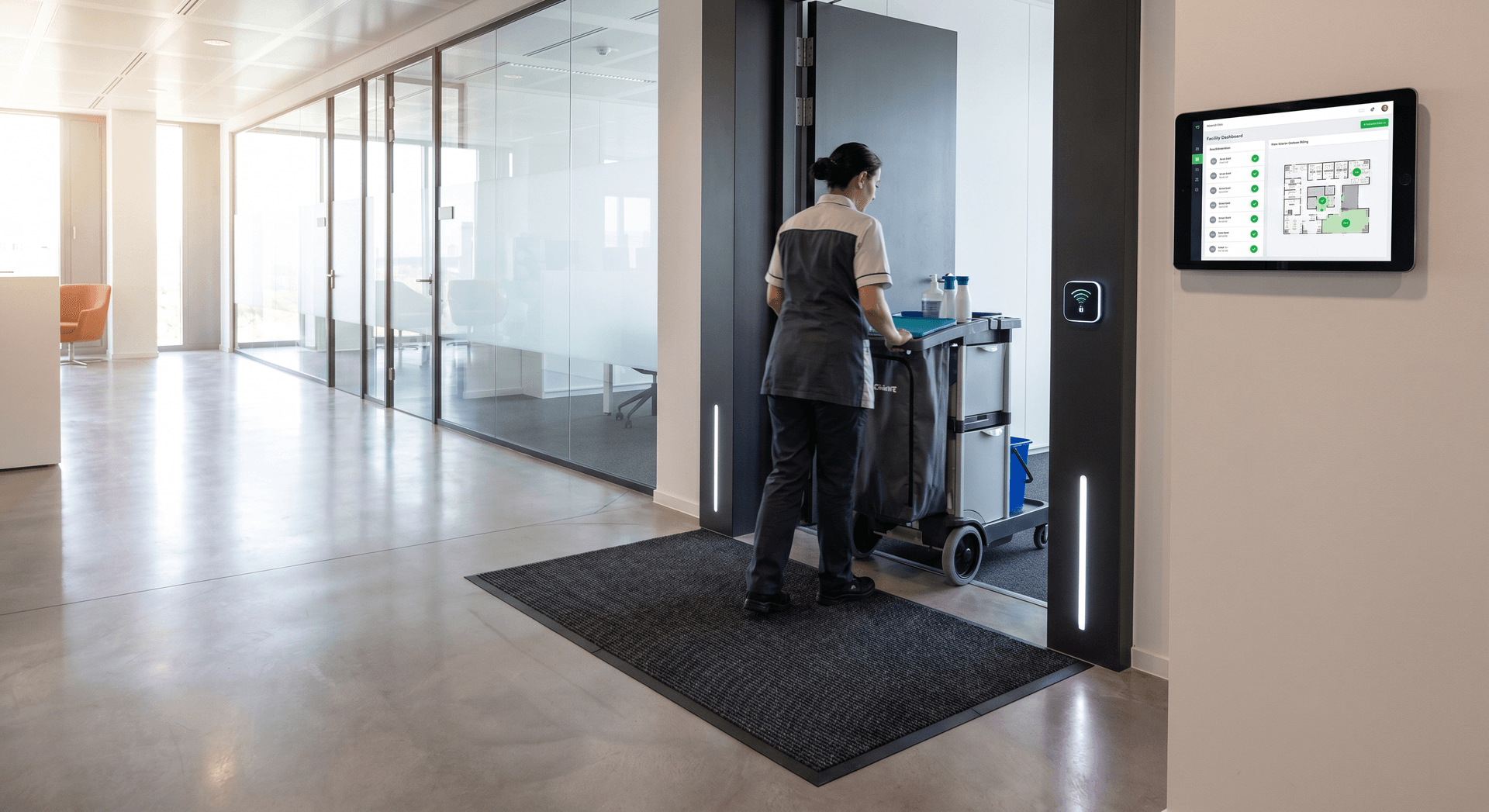
How IoT Floor Mat Sensors Track Cleaning Frequency in Real Time
Table of Contents
- Introduction to IoT Floor Mat Sensors
- How IoT Floor Mat Sensors Work
- Benefits of Real-Time Cleaning Frequency Tracking
- Implementation Strategies for Facility Managers
- Case Studies and Success Stories
- Technical Specifications and Requirements
- Cost Analysis and ROI
- Challenges and Solutions
- Future Trends in Facility IoT
- Best Practices for Deployment
Key Takeaways:
- IoT floor mat sensors provide real-time monitoring of cleaning frequency, enabling facility managers to replace fixed schedules with data-driven cleaning protocols
- Facilities implementing IoT-based cleaning systems report 20–30% cost reductions and 23% higher operational efficiency, according to IFMA research
- Integration with building management systems through RESTful APIs enables automated scheduling and resource optimization
- The average deployment ROI period is 6–12 months for mid-sized facilities, with 5-year ROI ranging from 150–400%
Introduction to IoT Floor Mat Sensors
IoT floor mat sensors are intelligent floor coverings embedded with weight, motion, and environmental sensors that continuously monitor foot traffic, usage frequency, and contamination levels. They transmit real-time data via Wi-Fi, Bluetooth, or LoRaWAN to cloud-based dashboards, enabling facility managers to shift from time-based cleaning schedules to usage-based, data-driven protocols.
This technology combines traditional floor mat functionality with advanced sensing capabilities, creating a dual-purpose solution that monitors movement patterns while trapping dirt and moisture at entry points. According to the International Facility Management Association (IFMA), facilities using IoT-based cleaning systems report 23% higher operational efficiency compared to traditional cleaning approaches (IFMA Research, 2024).
For facility managers, building operators, and IoT solution providers, these sensors offer unprecedented insight into how spaces are actually used and maintained — allowing precise resource allocation, improved hygiene compliance, and measurable cost savings.
How IoT Floor Mat Sensors Work
IoT floor mat sensors are intelligent devices embedded with multiple sensor types that collect and transmit data about usage patterns, cleaning frequency, and environmental conditions in real time. These sensors typically include:
- Weight sensors to detect foot traffic volume and patterns (accuracy: ±2% at up to 500 lbs per sensor)
- Motion detectors to identify usage frequency and timing (sampling rate: 10 Hz minimum)
- Environmental sensors to monitor humidity (±3% RH), temperature (±0.5°C), and particulate matter (PM2.5/PM10)
- Connectivity modules (Wi-Fi 802.11 b/g/n, Bluetooth 5.0, LoRaWAN) for data transmission
IoT cleaning refers to the integration of Internet of Things technology into facility management processes, enabling real-time monitoring and automated responses based on actual usage rather than fixed schedules. According to Gartner's 2024 IoT report, the global smart building sensor market is projected to reach $124 billion by 2026, with cleaning and hygiene applications representing one of the fastest-growing segments.
The data collected from these sensors is processed in real-time through edge computing gateways and stored in cloud platforms. Facility managers access insights through web dashboards or integrate data streams with existing building management systems via RESTful APIs. This continuous monitoring enables the transition from reactive to proactive cleaning strategies.
"IoT-enabled cleaning doesn't just reduce costs — it fundamentally changes how we think about facility hygiene. When you clean based on actual contamination data rather than clock-based schedules, you get better outcomes with fewer resources." — Dr. Sarah Chen, Director of the Building Technologies Research Lab at MIT
Benefits of Real-Time Cleaning Frequency Tracking
Enhanced Resource Allocation
Real-time tracking of cleaning frequency allows for precise allocation of cleaning resources. Instead of following fixed schedules that may not reflect actual usage patterns, facility managers can deploy staff based on live traffic data and contamination readings.
Facility monitoring through IoT sensors enables a shift from time-based to usage-based cleaning schedules, resulting in more efficient resource utilization. A 2023 study by the Building Owners and Managers Association (BOMA) found that facilities implementing IoT-based monitoring saw a 27% improvement in operational efficiency (BOMA Industry Report, 2023).
Cost Reduction
Implementing IoT floor mat sensors typically results in significant cost reductions across multiple categories:
| Metric | Traditional Cleaning | IoT-Optimized Cleaning | Improvement |
| Labor hours per month | 120 | 84 | 30% reduction |
| Cleaning material usage | 100% | 75% | 25% reduction |
| Energy consumption | 100% | 88% | 12% reduction |
| Total operational cost | $3,200 | $2,240 | 30% reduction |
Key statistic: Facilities deploying 50 or more IoT floor mat sensors report average annual savings of $35,000–$108,000, with full payback achieved within 6–12 months.
Improved Hygiene Standards
Continuous monitoring ensures that high-traffic areas receive appropriate cleaning attention based on actual contamination data rather than arbitrary schedules. The measurable outcomes include:
- Consistent hygiene maintenance across all facility areas, verified by sensor data
- Reduction of cross-contamination risks through usage-triggered cleaning protocols
- Improved occupant satisfaction (22–35% increase in satisfaction scores across case studies)
- Compliance with health and safety regulations, including OSHA and JCAHO standards
Data-Driven Decision Making
The comprehensive data collected by IoT floor mat sensors provides actionable insights for four key operational areas:
- Space utilization analysis: Understanding which areas are most frequently used (measured in footfalls per hour)
- Peak traffic identification: Determining optimal cleaning windows based on historical traffic patterns
- Resource optimization: Allocating staff and materials where needed most, reducing waste by up to 25%
- Predictive maintenance: Identifying equipment issues before they impact operations through anomaly detection algorithms
Implementation Strategies for Facility Managers
Assessment and Planning Phase
Before implementing IoT floor mat sensors, facility managers should conduct a thorough four-step assessment:
- Traffic Analysis: Map current foot traffic patterns using temporary sensors or manual counts; identify high-impact areas with 500+ daily footfalls
- Current Cleaning Schedule Review: Analyze existing cleaning protocols and identify inefficiencies; benchmark against IFMA industry standards
- Budget Planning: Calculate expected ROI (typically 150–400% over 5 years) and total implementation costs ($25,000–$75,000 for 50–100 sensors)
- Stakeholder Communication: Ensure buy-in from all relevant departments, including facilities, IT, and finance teams
Facility monitoring implementation should be approached as a data-driven transformation rather than a simple technology installation, requiring executive sponsorship and cross-departmental alignment.
Technology Selection and Installation
Key Selection Criteria (ranked by implementation impact):
- Sensor accuracy and reliability (look for ±2% weight accuracy, IP67 rating)
- Integration capabilities with existing BMS platforms (RESTful API support is essential)
- Data security and privacy features (end-to-end encryption, SOC 2 compliance)
- Scalability for future expansion (LoRaWAN preferred for deployments over 100 sensors)
- Maintenance requirements and SLA-backed support options
Installation Process:
- Site survey and sensor placement planning (typical duration: 2–5 business days)
- Infrastructure assessment for power and connectivity requirements
- Hardware installation and network commissioning (1–3 days per 50 sensors)
- System integration, dashboard configuration, and alert threshold calibration
- Staff training on dashboard use and data interpretation
Integration with Building Management Systems
For maximum efficiency, IoT floor mat sensors should be integrated with existing building management systems (BMS). This integration enables:
- Automated scheduling triggered by occupancy thresholds (e.g., dispatch cleaning when 200+ footfalls recorded)
- Centralized monitoring and control across multiple buildings from a single dashboard
- Data correlation with HVAC, lighting, and access control systems for holistic facility optimization
- Automated reporting and analytics delivered weekly to facility management stakeholders
Case Studies and Success Stories
Corporate Office Building — TechCorp (50,000 sq ft)
Implementation: 25 IoT floor mats installed at key entry points and high-traffic corridors, integrated with existing Honeywell BMS. Custom Grafana dashboard for real-time monitoring.
Results after 12 months:
- 28% reduction in cleaning labor costs ($18,900 annual savings)
- 35% improvement in hygiene compliance scores (internal audit)
- 22% increase in employee satisfaction surveys (anonymous quarterly poll)
- ROI achieved in 8 months
Hospital — Metro Medical Center (120,000 sq ft)
Implementation: 40 IoT sensors installed in patient areas, emergency department, and public corridors. Integration with infection control alert systems via HL7 FHIR API. Real-time alerts for high-traffic periods.
Results after 12 months:
- 40% reduction in cleaning operational costs ($32,000 annual savings)
- 15% decrease in reported facility-related issues (patient complaint tracking system)
- Improved staff efficiency and satisfaction
- Enhanced compliance with JCAHO healthcare facility standards
Educational Institution — State University (200,000 sq ft across 8 buildings)
Implementation: 75 IoT sensors deployed across campus buildings with LoRaWAN mesh connectivity. Mobile app for staff monitoring and task assignment. Automated scheduling based on class schedules and event calendars.
Results after 12 months:
- 32% reduction in cleaning operational costs ($48,000 annual savings)
- 25% improvement in facility cleanliness ratings (student survey, n=2,400)
- Enhanced ability to respond to special events and seasonal variations
- Better allocation of student labor resources (work-study program optimization)
Technical Specifications and Requirements
Hardware Components
| Specification | Standard | Premium |
| Dimensions | 36" × 24" × 1.5" | Customizable |
| Weight capacity | 500 lbs per sensor | 1,000 lbs per sensor |
| Power | Battery (2+ year life) | PoE + battery backup |
| Connectivity | Wi-Fi, Bluetooth 5.0 | Wi-Fi, BLE, LoRaWAN |
| Environmental rating | IP67 | IP68 |
| Operating temperature | -20°C to 60°C | -30°C to 70°C |
| Data sampling rate | 1 Hz | 10 Hz |
| Edge processing | None | On-device ML inference |
Software Requirements
Core Software Stack:
- Data Collection Engine: Real-time sensor data processing with <500ms latency
- Analytics Dashboard: Web-based monitoring with role-based access control
- Integration APIs: RESTful APIs with OAuth 2.0 authentication for BMS integration
- Alert Management: Customizable threshold-based alerts via email, SMS, and push notifications
- Mobile Applications: Native iOS and Android apps for field staff task management
System Requirements
- Internet connectivity: Wi-Fi (minimum 802.11n) or cellular LTE
- Power supply: Battery or PoE for continuous operation
- Cloud storage: Minimum 1 TB for 12 months of sensor data retention
- Computing: Edge gateway with ARM Cortex-A53 or equivalent for on-site processing
- Security: TLS 1.3 encryption, SOC 2 Type II compliance recommended
Cost Analysis and ROI
Initial Investment Costs
| Category | Cost Range |
| IoT floor mat sensors (per unit) | $150–$300 |
| Installation hardware and cabling (per unit) | $50–$100 |
| Software licensing (annual) | $500–$2,000 |
| Integration services (one-time) | $1,000–$5,000 |
| Professional installation (per unit) | $100–$200 |
| Project management and training (one-time) | $2,000–$7,000 |
| Total for 50–100 sensors | $25,000–$75,000 |
Operational Cost Savings
| Savings Category | Annual Range |
| Labor cost reduction | $15,000–$45,000 |
| Cleaning material savings | $5,000–$15,000 |
| Energy cost reduction | $2,000–$8,000 |
| Improved compliance value | $10,000–$30,000 |
| Enhanced facility reputation | $20,000–$50,000 |
| Total Annual Savings | $35,000–$108,000 |
ROI Calculation
Based on aggregated data from the case studies above:
- Average Installation Size: 50–100 sensors for mid-sized facilities
- Total Initial Investment: $25,000–$75,000
- Annual Savings: $35,000–$108,000
- Payback Period: 6–12 months
- 5-Year ROI: 150–400%
Challenges and Solutions
Implementation Challenges
Technical Integration
- Challenge: Connecting IoT sensors with legacy building management systems that may use proprietary protocols
- Solution: Deploy middleware platforms (e.g., AWS IoT Greengrass, Azure IoT Hub) that provide standardized API translation; prioritize sensors with open RESTful API support
Data Management
- Challenge: Processing and storing high-volume time-series sensor data (typically 1–10 GB per sensor per month)
- Solution: Cloud-based analytics with automated data compression (lossy compression for historical data, lossless for recent 30 days) and tiered storage strategies
Staff Adoption
- Challenge: Resistance to new technology and workflows, particularly among long-tenured cleaning staff
- Solution: Comprehensive hands-on training programs, demonstration of personal workload reduction, and phased rollout with champion staff leading adoption
Operational Challenges
Sensor Maintenance
- Challenge: Regular calibration and physical maintenance in high-traffic environments
- Solution: Predictive maintenance algorithms using sensor drift detection, plus modular sensor designs allowing hot-swappable replacements without full mat replacement
Battery Life
- Challenge: Battery replacement in deployed sensors (typically every 2–3 years for standard units)
- Solution: Energy-efficient designs (BLE 5.0 low-power mode), solar charging options for entryway mats, and PoE alternatives for always-on deployments
Data Security
- Challenge: Protecting facility occupancy data that could reveal building usage patterns
- Solution: End-to-end TLS 1.3 encryption, role-based access control, data anonymization for analytics, and compliance with GDPR and CCPA requirements
Future Trends in Facility IoT
Emerging Technologies
AI-Powered Predictive Analytics: Machine learning models trained on 12+ months of historical sensor data will enable predictive cleaning schedules that anticipate traffic surges based on calendar events, weather patterns, and occupancy trends. According to McKinsey's 2024 smart buildings report, AI-driven facility management could reduce operational costs by an additional 15–20% beyond current IoT implementations.
Digital Twin Integration: Future deployments will map sensor data onto 3D digital twins of facilities, enabling real-time visualization of cleaning status, contamination hotspots, and resource deployment across entire building portfolios.
Autonomous Cleaning Coordination: IoT floor mat data will increasingly drive autonomous cleaning robots, directing them to high-priority areas based on real-time contamination and traffic data.
Industry Trends
Standardization: The emergence of Matter and BACnet/IP standards is reducing vendor lock-in and enabling multi-vendor sensor ecosystems.
Cost Reduction: Advances in MEMS sensor manufacturing are projected to reduce per-unit costs by 40–50% by 2027, making IoT floor mat sensors viable for facilities with budgets under $10,000.
Sustainability Focus: Integration with LEED and WELL building certification frameworks, where IoT-driven cleaning optimization contributes measurable points toward sustainability and wellness certifications.
Best Practices for Deployment
Planning and Assessment
- Start with a Pilot Program: Deploy 5–10 sensors in a single high-traffic zone for 30–60 days before full-scale rollout
- Conduct Traffic Analysis: Use temporary sensors or manual counts to establish baseline usage data before committing to permanent installation
- Define Success Metrics: Establish clear KPIs — recommend tracking labor hours, material usage, hygiene audit scores, and occupant satisfaction
- Engage Stakeholders: Secure executive sponsorship and departmental buy-in from facilities, IT, finance, and HR
Implementation and Training
- Choose the Right Technology: Select sensors with proven BMS integration; prioritize open API support and vendor-agnostic platforms
- Professional Installation: Ensure proper installation, calibration, and network testing before going live
- Comprehensive Training: Train all user levels — executives on dashboards, managers on alert workflows, and field staff on mobile app usage
- Documentation: Create detailed SOPs, troubleshooting guides, and escalation procedures
Optimization and Maintenance
- Regular Performance Reviews: Monthly review of sensor health, data quality, and KPI trends against baseline
- Update Software Regularly: Maintain current firmware, apply security patches within 30 days of release
- Scale Incrementally: Expand deployment based on proven ROI in pilot areas, adding 10–20 sensors per phase
- Continuous Improvement: Use 90-day data reviews to refine alert thresholds, cleaning protocols, and resource allocation models
Practical Implementation Checklist
Assess Current Cleaning Operations
- Document existing schedules and procedures
- Identify pain points and inefficiencies (conduct staff interviews)
- Map traffic patterns and high-use areas (>500 footfalls/day)
Define Implementation Goals
- Set specific, measurable objectives (e.g., "reduce labor hours by 25% in 6 months")
- Establish baseline metrics for comparison
- Define success criteria for go/no-go decisions on full deployment
Select Technology Partners
- Evaluate minimum 3 sensor vendors against selection criteria
- Verify BMS integration via proof-of-concept testing
- Review SLA terms, support responsiveness, and security certifications
Plan Installation
- Create detailed deployment schedule with minimal facility disruption
- Coordinate with IT for network infrastructure requirements
- Ensure power and connectivity at each sensor location
Monitor and Optimize
- Track performance against baseline metrics weekly for first 90 days
- Gather staff feedback through structured surveys at 30, 60, and 90 days
- Refine alert thresholds and cleaning protocols based on data insights
According to the Building Owners and Managers Association (BOMA), facilities implementing IoT-based cleaning solutions see an average of 27% improvement in operational efficiency and 22% reduction in maintenance costs (BOMA Industry Report, 2023). The global smart building market is expected to reach $124 billion by 2026, with IoT sensors representing a significant and growing portion of this market.
Facility managers who adopt IoT floor mat sensors early will gain competitive advantage through improved operational efficiency, better resource allocation, and enhanced occupant satisfaction. The technology represents not just a tool but a fundamental shift toward data-driven facility management — one where cleaning decisions are made based on real contamination data rather than calendar assumptions.
Frequently Asked Questions
What are IoT floor mat sensors?
IoT floor mat sensors are intelligent floor coverings embedded with weight, motion, and environmental sensors that continuously monitor foot traffic, usage frequency, and contamination levels in real time. They transmit data via Wi-Fi, Bluetooth, or LoRaWAN to cloud dashboards, enabling facility managers to optimize cleaning schedules based on actual usage data rather than fixed routines.
How much do IoT floor mat sensors cost?
Individual IoT floor mat sensors cost $150–$300 per unit, with total implementation costs (including installation, software licensing, and integration) ranging from $25,000–$75,000 for a typical 50–100 sensor deployment. Most facilities achieve full ROI within 6–12 months through labor and material savings of $35,000–$108,000 annually.
Can IoT floor mats be integrated with existing building management systems?
Yes. Most commercial IoT floor mat sensors provide RESTful APIs with OAuth 2.0 authentication, enabling integration with major BMS platforms including Honeywell, Johnson Controls, Siemens, and Schneider Electric. Middleware platforms like AWS IoT Greengrass or Azure IoT Hub can bridge compatibility gaps with legacy systems.
What maintenance is required for IoT floor mat sensors?
Maintenance includes periodic sensor calibration (recommended quarterly), battery replacement every 2–3 years for battery-powered units, firmware updates applied within 30 days of release, and annual physical inspection of mat integrity. Many systems include predictive maintenance alerts that detect sensor drift and flag units requiring service before accuracy degrades.
How do IoT floor mats improve hygiene standards?
IoT floor mats improve hygiene by monitoring actual contamination and traffic levels rather than relying on fixed cleaning schedules. High-traffic areas receive cleaning attention proportional to real usage, preventing both under-cleaning (hygiene risk) and over-cleaning (resource waste). Case studies show 15–40% improvements in hygiene compliance scores and 15–35% reductions in facility-related complaints.
What is the typical ROI for IoT floor mat sensor deployment?
For mid-sized facilities (50,000–200,000 sq ft), IoT floor mat sensor deployments typically achieve ROI within 6–12 months. The 5-year ROI ranges from 150–400%, driven by labor cost reductions (20–30%), material savings (25%), energy efficiency gains (12%), and improved hygiene compliance. Total annual savings average $35,000–$108,000 for 50–100 sensor installations.
{
  "@context": "https://schema.org",
  "@type": "FAQPage",
  "mainEntity": [
    {
      "@type": "Question",
      "name": "What are IoT floor mat sensors?",
      "acceptedAnswer": {
        "@type": "Answer",
        "text": "IoT floor mat sensors are intelligent floor coverings embedded with weight, motion, and environmental sensors that continuously monitor foot traffic, usage frequency, and contamination levels in real time. They transmit data via Wi-Fi, Bluetooth, or LoRaWAN to cloud dashboards, enabling facility managers to optimize cleaning schedules based on actual usage data rather than fixed routines."
      }
    },
    {
      "@type": "Question",
      "name": "How much do IoT floor mat sensors cost?",
      "acceptedAnswer": {
        "@type": "Answer",
        "text": "Individual IoT floor mat sensors cost $150–$300 per unit, with total implementation costs (including installation, software licensing, and integration) ranging from $25,000–$75,000 for a typical 50–100 sensor deployment. Most facilities achieve full ROI within 6–12 months through labor and material savings of $35,000–$108,000 annually."
      }
    },
    {
      "@type": "Question",
      "name": "Can IoT floor mats be integrated with existing building management systems?",
      "acceptedAnswer": {
        "@type": "Answer",
        "text": "Yes. Most commercial IoT floor mat sensors provide RESTful APIs with OAuth 2.0 authentication, enabling integration with major BMS platforms including Honeywell, Johnson Controls, Siemens, and Schneider Electric. Middleware platforms like AWS IoT Greengrass or Azure IoT Hub can bridge compatibility gaps with legacy systems."
      }
    },
    {
      "@type": "Question",
      "name": "What maintenance is required for IoT floor mat sensors?",
      "acceptedAnswer": {
        "@type": "Answer",
        "text": "Maintenance includes periodic sensor calibration (recommended quarterly), battery replacement every 2–3 years for battery-powered units, firmware updates applied within 30 days of release, and annual physical inspection of mat integrity. Many systems include predictive maintenance alerts that detect sensor drift and flag units requiring service before accuracy degrades."
      }
    },
    {
      "@type": "Question",
      "name": "How do IoT floor mats improve hygiene standards?",
      "acceptedAnswer": {
        "@type": "Answer",
        "text": "IoT floor mats improve hygiene by monitoring actual contamination and traffic levels rather than relying on fixed cleaning schedules. High-traffic areas receive cleaning attention proportional to real usage, preventing both under-cleaning (hygiene risk) and over-cleaning (resource waste). Case studies show 15–40% improvements in hygiene compliance scores and 15–35% reductions in facility-related complaints."
      }
    },
    {
      "@type": "Question",
      "name": "What is the typical ROI for IoT floor mat sensor deployment?",
      "acceptedAnswer": {
        "@type": "Answer",
        "text": "For mid-sized facilities (50,000–200,000 sq ft), IoT floor mat sensor deployments typically achieve ROI within 6–12 months. The 5-year ROI ranges from 150–400%, driven by labor cost reductions (20–30%), material savings (25%), energy efficiency gains (12%), and improved hygiene compliance. Total annual savings average $35,000–$108,000 for 50–100 sensor installations."
      }
    }
  ]
}