
How Smart Air Quality Monitoring Improves Office Worker Productivity by 15%

How Smart Air Quality Monitoring Improves Office Worker Productivity by 15%
Table of Contents
- Key Takeaways:
- Introduction
- The Hidden Productivity Drain: Understanding Indoor Air Quality in Offices
- What Is Smart Air Quality Monitoring?
- How Air Quality Monitoring Translates Into a 15% Productivity Gain
- Implementing Smart Air Quality Monitoring: A Practical Guide for Facility Managers
- LBS Smarttech: Your Partner in Smart Building Air Quality
- Frequently Asked Questions
- Conclusion
Key Takeaways:
- Poor indoor air quality (IAQ) costs businesses billions annually through lost productivity, sick days, and cognitive impairment — yet most facilities still rely on periodic manual testing.
- Smart air quality monitoring using IoT sensors provides continuous, real-time data on CO₂, VOCs, particulate matter, humidity, and temperature across your entire office.
- Research from Harvard T.H. Chan School of Public Health demonstrates that occupants in well-ventilated, green-certified buildings score significantly higher on cognitive function tests — translating to roughly 15% higher productivity.
- LBS Smarttech's integrated air quality monitoring solutions give facility managers the visibility and control to optimize ventilation dynamically, reduce energy waste, and create environments where employees perform at their best.
Introduction
Walk into any modern office building and you'll find investments in ergonomic furniture, standing desks, premium coffee, and wellness programs — all aimed at keeping employees happy and productive. Yet there's an invisible factor that profoundly affects how people think, focus, and perform every single day, and it's almost entirely overlooked: the air they breathe.
Indoor air quality (IAQ) has been called "the next frontier of workplace wellness," and for good reason. The air inside commercial buildings can be two to five times more polluted than outdoor air, according to the U.S. Environmental Protection Agency (EPA). For a facility manager, this isn't just a health concern — it's a direct line to the company's bottom line. When CO₂ levels climb, decision-making slows. When volatile organic compounds (VOCs) accumulate, headaches increase and concentration drops. When humidity swings out of range, fatigue sets in.
The solution isn't more frequent HVAC filter changes or opening a few windows. It's smart air quality monitoring — a network of IoT-connected sensors that continuously track environmental conditions and feed actionable data to facility managers in real time. When deployed correctly, these systems don't just improve air quality; they measurably improve the cognitive performance and productivity of every person in the building. Multiple studies, including landmark research from Harvard University, have quantified this gain at approximately 15%.
This article explores exactly how smart air quality monitoring achieves this, the science behind it, and how facility managers can implement these systems to create healthier, higher-performing workplaces — with LBS Smarttech's solutions leading the way.
The Hidden Productivity Drain: Understanding Indoor Air Quality in Offices
Most facility managers understand that IAQ matters. What's less understood is the magnitude of its impact on the people working inside the building every day. The relationship between air quality and human cognitive performance isn't theoretical — it's well-documented, measurable, and significant.
Indoor environments in office buildings are subject to a unique set of pollution sources. Carpeting and furniture off-gas formaldehyde and other VOCs. Photocopiers emit ozone. Human occupants produce CO₂ with every breath. Cleaning chemicals introduce additional compounds. And the building's HVAC system, designed to mitigate these issues, may be inadequately maintained, improperly balanced, or simply not designed for the occupancy levels the building now experiences.
The World Green Building Council estimates that poor indoor environments cost the global economy approximately $130 billion annually in lost productivity, with healthcare costs adding another $30 billion. In the United States alone, the annual cost of poor IAQ is estimated at $60 billion, encompassing direct healthcare expenses, lost workdays, and diminished output while at work. These are not small numbers — they represent a massive, largely invisible drain on organizational performance.
The CO₂–Cognition Connection
Carbon dioxide is perhaps the most insidious indoor air pollutant because it's invisible, odorless at moderate levels, and directly tied to human metabolism. Every person in an office exhales roughly 0.04 cubic meters of CO₂ per hour. In a well-ventilated space, this is continuously diluted with fresh outdoor air. But in poorly ventilated meeting rooms, open-plan offices, or buildings with aging HVAC systems, CO₂ concentrations can climb rapidly.
The impact of elevated CO₂ on cognitive function has been extensively studied. A widely cited 2016 study from the Harvard T.H. Chan School of Public Health and SUNY Upstate Medical University, published in Environmental Health Perspectives, placed 24 professionals in controlled office environments and tested their cognitive function across different ventilation conditions. The results were striking:
- At 600 ppm CO₂ (well-ventilated conditions), participants scored an average of 101% higher on strategic thinking and 131% higher on crisis response compared to conventional building conditions.
- At 1,000 ppm CO₂ (a level commonly found in many offices), cognitive scores declined measurably on tests involving information usage, strategy, and decision-making.
- At 2,500 ppm CO₂ (levels sometimes reached in crowded meeting rooms), performance deteriorated dramatically across all cognitive domains.
The implications are clear: the difference between a well-ventilated and poorly ventilated office isn't just comfort — it's the cognitive capacity of your entire workforce. For a company with 500 office employees earning an average of $75,000 annually, even a modest productivity improvement translates to millions of dollars in added value.
VOCs, Particulates, and Their Impact on Cognitive Performance
While CO₂ gets the most attention, it's far from the only airborne factor affecting office workers. Volatile organic compounds — emitted by building materials, office equipment, cleaning products, and even personal care products — create a chemical soup that can impair cognitive function, cause headaches, trigger allergic responses, and contribute to the phenomenon known as "sick building syndrome."
A comprehensive study led by researchers at the Harvard T.H. Chan School of Public Health, published in 2021 in Nature Human Behaviour, tracked the cognitive performance of over 300 white-collar workers across six countries. The study found that even low levels of VOCs and fine particulate matter (PM2.5) had statistically significant negative effects on response times and the accuracy of cognitive tasks. Workers exposed to higher concentrations of VOCs demonstrated slower decision-making and reduced ability to focus on complex tasks.
Particulate matter, particularly PM2.5 (particles smaller than 2.5 micrometers), poses an additional threat. These fine particles can penetrate deep into the lungs and even enter the bloodstream. In office environments, PM2.5 can originate from outdoor pollution infiltrating the building, printer toner emissions, cooking in break areas, and even dust generated by HVAC systems. Chronic exposure has been linked not only to respiratory and cardiovascular problems but also to measurable cognitive decline.
Temperature and humidity, while not pollutants per se, play a critical mediating role. Research consistently shows that cognitive performance peaks in a narrow temperature range — typically 21–24°C (70–75°F). Beyond this range, both overheating and overcooling impair concentration and increase error rates. Similarly, humidity outside the 40–60% range can cause discomfort, dry eyes, respiratory irritation, and fatigue, all of which undermine productivity.
The Financial Cost of Poor Indoor Air Quality
For facility managers making the case for IAQ investment, the financial data is compelling. Consider these calculations:
Lost productivity from poor air quality:
- Average annual salary per office worker: $75,000
- Estimated productivity loss from poor IAQ: 8–15%
- Cost per worker per year: $6,000–$11,250
- For a 500-person office: $3,000,000–$5,625,000 annually
Sick leave and healthcare costs:
- Average sick days per employee in the U.S.: 7.7 per year (Bureau of Labor Statistics)
- Estimated IAQ-related sick days attributed to poor ventilation: 1–2 additional days per year
- Cost per sick day (salary + lost productivity): approximately $350–$500
- For a 500-person office: $175,000–$500,000 annually
These are conservative estimates. Buildings with known IAQ problems — those with documented ventilation deficiencies, moisture issues, or renovation-related off-gassing — can see significantly higher costs. The total economic impact of poor indoor air quality on a single large office building can easily exceed $5 million per year, making IAQ optimization one of the highest-ROI investments a facility manager can make.
What Is Smart Air Quality Monitoring?
Smart air quality monitoring is the deployment of a network of IoT-enabled sensors throughout a building or campus to continuously measure, record, and report on key indoor environmental parameters. Unlike traditional IAQ assessments — which typically involve a consultant visiting once a year with portable equipment and providing a snapshot report — smart monitoring provides 24/7, granular visibility into the air quality conditions your occupants are actually experiencing.
Core Sensors and Metrics
A comprehensive smart air quality monitoring system typically includes sensors for the following parameters:
| Metric | What It Measures | Healthy Range | Impact When Outside Range |
| CO₂ | Carbon dioxide concentration (indicator of ventilation adequacy) | < 800 ppm optimal; < 1,000 ppm acceptable | Cognitive decline, drowsiness, reduced decision-making ability above 1,000 ppm |
| PM2.5 | Fine particulate matter (< 2.5μm) | < 12 μg/m³ (WHO guideline) | Respiratory irritation, cognitive impairment, long-term health risks |
| TVOC | Total volatile organic compounds | < 500 ppb | Headaches, eye irritation, reduced concentration, nausea |
| Temperature | Ambient air temperature | 21–24°C (70–75°F) | Discomfort, fatigue, reduced cognitive performance outside optimal range |
| Relative Humidity | Moisture content in the air | 40–60% | Dry eyes, respiratory irritation (low); mold risk, discomfort (high) |
| CO | Carbon monoxide | < 9 ppm (ASHRAE) | Headaches, dizziness at elevated levels |
| Noise | Ambient noise levels | 40–50 dB for focused work | Distraction, stress, reduced concentration |
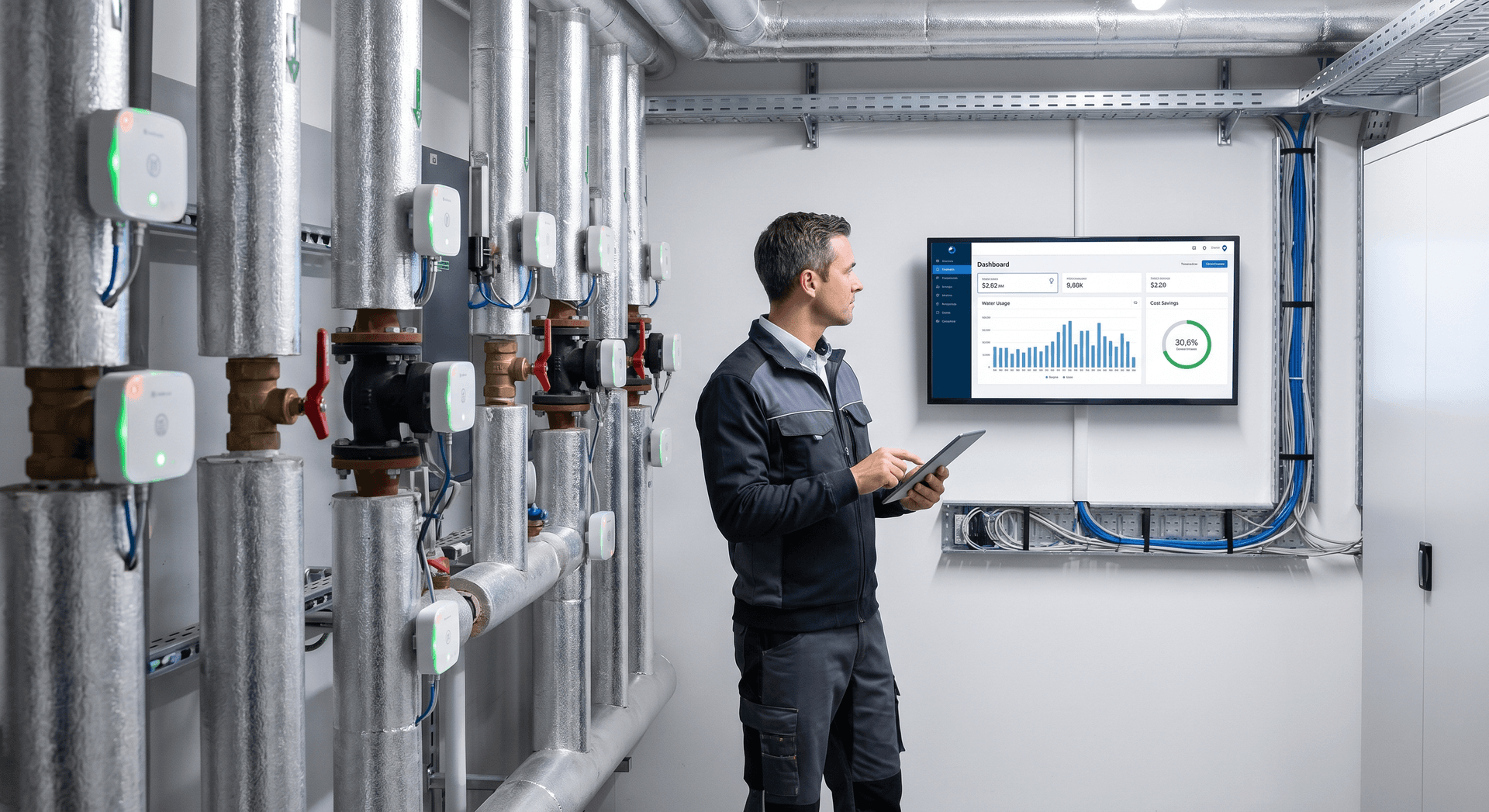
Modern IoT air quality sensors combine multiple of these measurements into compact, wireless devices that can be installed on walls, ceilings, or integrated into existing building infrastructure. They're designed for minimal maintenance — most require calibration only once every 1–2 years and operate on battery or low-power PoE connections.
How the Data Flows: From Sensor to Decision
The real power of smart air quality monitoring lies not in the sensors themselves, but in how their data is processed and delivered. Here's how a typical system works:
Data Collection: Sensors continuously measure environmental parameters at intervals as short as every 30 seconds, transmitting data wirelessly to a central gateway or directly to the cloud via Wi-Fi, LoRaWAN, or cellular connections.
Cloud Processing: Data is received by a cloud platform where it's normalized, validated, and stored. Advanced platforms apply machine learning algorithms to detect patterns, predict trends, and identify anomalies.
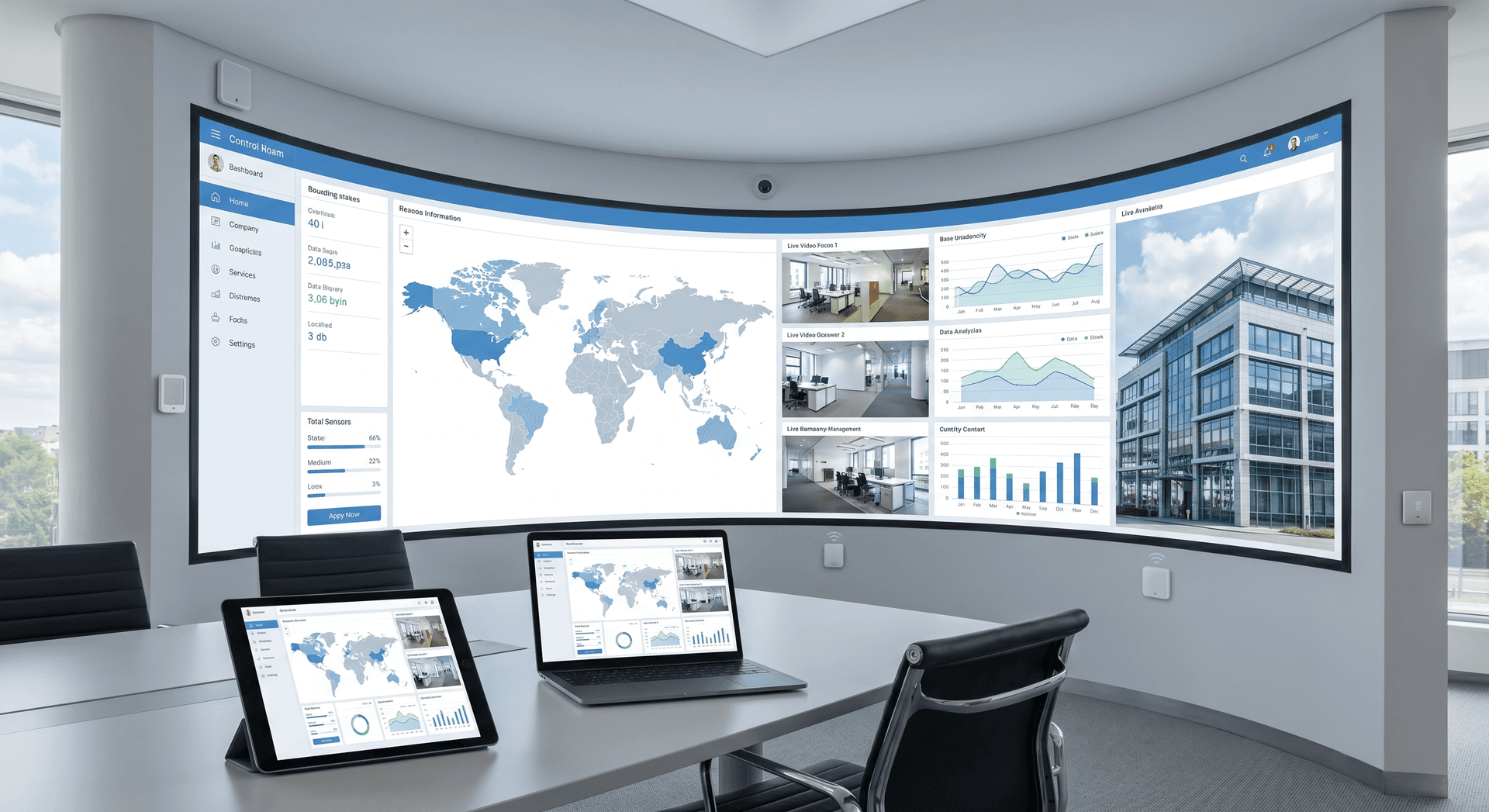
Real-Time Dashboards: Facility managers access live dashboards showing current conditions across all monitored zones. Color-coded maps make it easy to spot problem areas at a glance — a conference room where CO₂ is trending toward 1,200 ppm, a server room where temperature is creeping up, or an area where VOC levels have spiked after a cleaning event.
Automated Alerts and Actions: When parameters exceed predefined thresholds, the system generates alerts via email, SMS, or push notification. More advanced systems can integrate directly with the building management system (BMS) to trigger automated responses — increasing ventilation in a zone where CO₂ is rising, for example, or adjusting damper positions to route more fresh air to areas with elevated VOCs.
Historical Analytics and Reporting: Over time, accumulated data enables trend analysis, compliance reporting, and ROI calculation. Facility managers can generate reports showing air quality improvements, correlate IAQ data with occupancy patterns, and demonstrate the financial impact of their optimization efforts to building owners and C-suite executives.
This continuous feedback loop — measure, analyze, act, measure again — is what transforms air quality monitoring from a passive reporting tool into an active productivity optimization engine.
How Air Quality Monitoring Translates Into a 15% Productivity Gain
The claim that smart air quality monitoring can improve productivity by 15% isn't marketing hyperbole — it's grounded in rigorous scientific research. Multiple studies using different methodologies across different countries have arrived at remarkably consistent findings.
The Research Behind the Numbers
The COGfx Study (Harvard T.H. Chan School of Public Health, 2016): This landmark double-blind study examined 24 professionals across six days in a controlled office environment. Researchers manipulated ventilation rates, CO₂ levels, and VOC levels to simulate three building conditions: conventional, green (low-VOC), and green+ (enhanced ventilation with low-VOC). Key findings:
- Participants in green building conditions scored 61% higher on cognitive function tests compared to conventional conditions.
- Participants in green+ conditions scored 101% higher on strategic thinking.
- The largest gains were in domains most critical for knowledge workers: information usage, strategy, and crisis response.
The Global COGfx Study (2021): Expanding to over 300 participants across six countries (China, India, Mexico, Thailand, the U.K., and the U.S.), this study validated the original findings in diverse climates and building types. It confirmed that improved ventilation and reduced pollutant exposure consistently enhanced cognitive performance, with the average productivity improvement estimated at 8–15% across the full study population.
The WELL Building Standard Impact Study (2018): The International WELL Building Institute conducted an analysis of buildings certified under the WELL Building Standard — which includes stringent IAQ requirements — and found that occupants reported 28% higher satisfaction with their work environment and 10–15% higher self-reported productivity compared to conventional buildings.
The Cost-Benefit Analysis (Lawrence Berkeley National Laboratory, 2020): Researchers at LBNL calculated that doubling the ventilation rate in a typical office building would increase energy costs by approximately $10–$15 per person per year, while the associated productivity gain (estimated at $4,000–$6,500 per person per year) represents an ROI of 300:1 or higher.
These studies converge on a clear conclusion: optimizing indoor air quality isn't a luxury — it's one of the most cost-effective productivity investments available. The 15% figure represents a conservative, evidence-based estimate of the productivity improvement achievable when buildings maintain optimal IAQ conditions through smart monitoring and responsive ventilation management.
Real-World Impact Scenarios
To understand what a 15% productivity gain looks like in practice, consider these scenarios:
Scenario 1: The Open-Plan Office A 200-person open-plan office experiences CO₂ levels averaging 1,100 ppm by mid-afternoon, with PM2.5 occasionally elevated due to nearby construction. After installing smart air quality sensors and integrating them with the HVAC system to dynamically adjust ventilation based on real-time demand:
- Average CO₂ drops to 750 ppm.
- Workers report fewer afternoon headaches and improved concentration.
- Project completion times decrease by approximately 12–15%.
- Annual value of productivity gains: approximately $1.8–$2.25 million.
Scenario 2: The Meeting Room Problem A company's executive meeting rooms regularly reach CO₂ levels above 1,800 ppm during 90-minute strategy sessions. Smart sensors detect the rise in real time and automatically increase fresh air supply. Post-implementation surveys show that meeting participants feel more alert and decisions are reached faster. The company estimates that the improvement in meeting effectiveness alone saves roughly $500,000 annually in executive time.
Scenario 3: Post-Renovation VOC Management After an office renovation, elevated formaldehyde and other VOCs from new carpeting and furniture caused widespread complaints of headaches and eye irritation across three floors. Smart air quality sensors identified the problem zones immediately, allowing targeted ventilation and, where needed, supplemental air purification. Complaints dropped by 90% within two weeks, and the early detection prevented what could have been a prolonged period of reduced productivity across approximately 150 workers.
Implementing Smart Air Quality Monitoring: A Practical Guide for Facility Managers
Moving from understanding the benefits to actually implementing a smart air quality monitoring system requires careful planning. Here's a step-by-step approach based on best practices from leading facility management organizations.
Step 1: Conduct a Baseline IAQ Assessment
Before deploying any technology, establish your starting point. Hire a qualified IAQ consultant or use portable monitoring equipment to assess current conditions across your building. Key activities include:
- Measuring CO₂, PM2.5, TVOC, temperature, and humidity in representative spaces (open offices, meeting rooms, break areas, server rooms).
- Testing during different occupancy patterns (peak hours, off-peak hours, after-hours).
- Reviewing HVAC system performance, including outdoor air damper settings, filter conditions, and airflow balancing.
- Documenting occupant complaints and health-related absenteeism data for comparison.
This baseline gives you the data to quantify improvement after implementation and helps prioritize which zones need the most attention.
Step 2: Select the Right Sensor Deployment Strategy
Not all spaces need the same level of monitoring. Develop a deployment plan based on zone criticality and occupancy patterns:
- High-priority zones: Large open-plan offices, conference rooms, call centers, and training rooms — these spaces have the highest occupancy and the greatest impact from air quality fluctuations. Deploy one sensor approximately every 500–1,000 square feet.
- Medium-priority zones: Private offices, break rooms, corridors — deploy one sensor per zone or every 1,500–2,000 square feet.
- Special-purpose zones: Server rooms, laboratories, fitness centers, and any areas with unique pollutant sources require dedicated sensors with appropriate measurement capabilities.
When selecting sensors, prioritize devices that measure CO₂, PM2.5, and TVOC at minimum, along with temperature and humidity. Ensure the sensors you choose support your preferred communication protocol (Wi-Fi, LoRaWAN, BACnet) and can integrate with your existing BMS or cloud platform.
Step 3: Integrate with Your Building Management System
The real value of smart air quality monitoring is unlocked when sensor data feeds directly into your building management system. This integration enables:
- Demand-controlled ventilation (DCV): Adjusting outdoor air intake based on real-time CO₂ and occupancy data rather than fixed schedules, saving energy while maintaining optimal air quality.
- Automated response: When sensors detect deteriorating conditions, the BMS can automatically increase fan speeds, adjust damper positions, or activate air purification systems.
- Centralized visibility: Facility managers can view IAQ data alongside HVAC performance data on a single dashboard, making it easier to diagnose issues and optimize system performance.
If your BMS doesn't support direct IoT integration, consider an intermediate middleware platform that can bridge the gap. Many modern IAQ platforms offer API-based integration with major BMS vendors.
Step 4: Establish Alert Thresholds and Response Protocols
Define clear thresholds for each monitored parameter based on relevant standards (ASHRAE 62.1, WHO guidelines, WELL Building Standard) and your building's specific requirements. For example:
- CO₂: Alert at 800 ppm (early warning), escalate at 1,000 ppm (action required).
- PM2.5: Alert at 15 μg/m³, escalate at 25 μg/m³.
- TVOC: Alert at 500 ppb, escalate at 1,000 ppb.
- Temperature: Alert when outside 20–25°C range.
- Humidity: Alert when below 30% or above 65%.
For each alert level, define a response protocol — who gets notified, what actions should be taken (e.g., increase ventilation, check for pollutant sources, notify occupants), and the expected resolution time. Escalation procedures should ensure that critical issues (e.g., CO above 10 ppm, PM2.5 above 50 μg/m³) trigger immediate action.
Step 5: Monitor, Optimize, and Report
After deployment, the work is just beginning. Use the continuous data stream to:
- Identify patterns: Does CO₂ consistently spike at 2 PM in the main conference room? Does PM2.5 rise when the HVAC switches to recirculation mode in the morning? These patterns reveal optimization opportunities.
- Validate improvements: Compare post-deployment IAQ data against your baseline assessment to quantify improvements.
- Calculate ROI: Track metrics like energy consumption, occupant satisfaction scores, absenteeism rates, and productivity indicators to demonstrate the financial return on your IAQ investment.
- Maintain compliance: Generate automated reports to demonstrate compliance with ASHRAE, LEED, WELL, or local building codes.
- Continuously optimize: Use data analytics to fine-tune HVAC schedules, identify equipment issues before they cause air quality problems, and plan preventative maintenance more effectively.
LBS Smarttech: Your Partner in Smart Building Air Quality
When it comes to implementing smart air quality monitoring at scale, the technology is only as effective as the partner behind it. LBS Smarttech (https://lbs-smarttech.com/) provides end-to-end smart building solutions designed specifically for the challenges facility managers face every day.
LBS Smarttech's air quality monitoring platform combines enterprise-grade IoT sensors with an intuitive cloud dashboard and seamless BMS integration. Their solutions are designed to deliver:
- Comprehensive coverage: Multi-parameter sensors measuring CO₂, PM2.5, TVOC, temperature, humidity, and more — providing complete visibility into your building's indoor environment.
- Real-time intelligence: Live dashboards, trend analysis, and predictive alerts that enable proactive facility management rather than reactive firefighting.
- Automated optimization: Direct integration with HVAC systems for demand-controlled ventilation, ensuring optimal air quality while minimizing energy consumption.
- Scalable deployment: From single buildings to multi-site portfolios, LBS Smarttech's platform scales to meet the needs of any organization.
- Actionable reporting: Automated compliance reports, ROI calculations, and executive summaries that help you demonstrate the value of your IAQ investments.
What sets LBS Smarttech apart is their deep understanding of facility management workflows. Their platform is built not as a standalone tech product, but as a practical tool that integrates into how facility managers actually work — providing the right data, at the right time, in the right format to make confident decisions.
Whether you're managing a single office building or a national portfolio, LBS Smarttech's smart air quality solutions provide the foundation for a healthier, more productive workplace and a stronger bottom line.
Frequently Asked Questions
Q: How accurate are IoT air quality sensors compared to professional monitoring equipment? A: Modern enterprise-grade IoT sensors have achieved accuracy levels within 5–10% of professional reference-grade instruments for CO₂, PM2.5, and temperature. For VOCs, accuracy varies more widely depending on the sensor technology (photoionization vs. metal oxide), but trends and relative changes are highly reliable. The key advantage of IoT sensors isn't absolute precision — it's continuous monitoring that captures conditions throughout the day, across all zones, that periodic professional assessments simply cannot.
Q: What is the typical ROI for smart air quality monitoring? A: Lawrence Berkeley National Laboratory estimates an ROI of 300:1 or higher when comparing the energy cost of improved ventilation against the resulting productivity gains. For a typical deployment in a medium-sized office building, most organizations see a full return on their sensor investment within 3–6 months, with ongoing savings accumulating annually through reduced absenteeism, lower energy costs (from optimized DCV), and improved tenant satisfaction and retention.
Q: Do smart air quality sensors require frequent calibration? A: Most modern IoT air quality sensors use auto-baseline correction algorithms that minimize the need for manual calibration. CO₂ sensors based on NDIR (non-dispersive infrared) technology are inherently stable and typically only require calibration every 2–3 years. PM2.5 sensors may need annual calibration depending on the dust loading of the environment. Your solution provider should include calibration as part of their maintenance offering.
Q: Can smart air quality monitoring help with LEED or WELL certification? A: Absolutely. Both LEED (Leadership in Energy and Environmental Design) and the WELL Building Standard award credits for continuous air quality monitoring. LEED v4.1 awards points for real-time IAQ monitoring and display, while WELL requires continuous monitoring as a precondition for several features. LBS Smarttech's platform can generate the documentation and data needed to support these certifications.
Q: How does demand-controlled ventilation save energy while improving air quality? A: Traditional HVAC systems deliver a fixed amount of outdoor air regardless of actual occupancy, often over-ventilating empty spaces (wasting energy) and under-ventilating crowded ones (compromising air quality). DCV uses real-time CO₂ or occupancy data to modulate outdoor air intake, delivering more fresh air when and where it's needed and reducing it when spaces are empty. This typically saves 20–40% on HVAC energy costs while maintaining or improving air quality.
Q: What's the typical deployment timeline for a smart air quality monitoring system? A: For a single commercial building, deployment typically takes 2–4 weeks from site assessment to full operation, including sensor installation, network configuration, BMS integration, and dashboard setup. Multi-site deployments follow a phased approach, typically completing 2–5 buildings per week once the initial site assessments are complete.
Conclusion
The evidence is overwhelming: the air inside our buildings has a profound, measurable impact on the cognitive performance and productivity of everyone who breathes it. For too long, facility managers have had to manage indoor environments blind — relying on infrequent assessments, gut feelings, and occupant complaints to identify problems that may have been silently eroding productivity for months or years.
Smart air quality monitoring changes this equation entirely. By deploying a network of IoT sensors that provide continuous, real-time visibility into indoor environmental conditions, facility managers gain the power to optimize their buildings proactively — improving air quality, reducing energy waste, and creating environments where employees can perform at their best.
The 15% productivity improvement isn't an aspiration — it's an evidence-based outcome that organizations around the world are already achieving. The research is clear, the technology is mature, and the financial case is compelling. The question isn't whether to implement smart air quality monitoring, but how quickly you can get it done.
With LBS Smarttech's comprehensive smart building solutions, facility managers have a trusted partner to guide them through every step — from initial assessment and sensor deployment through BMS integration and ongoing optimization. The air in your building is either working for you or against you. Smart monitoring ensures it's always on your side.
Ready to unlock the full potential of your building? Visit LBS Smarttech to learn more about their smart air quality monitoring solutions and start your journey toward a healthier, more productive workplace.
#SmartFacility #IoT #FacilityManagement #SmartBuilding