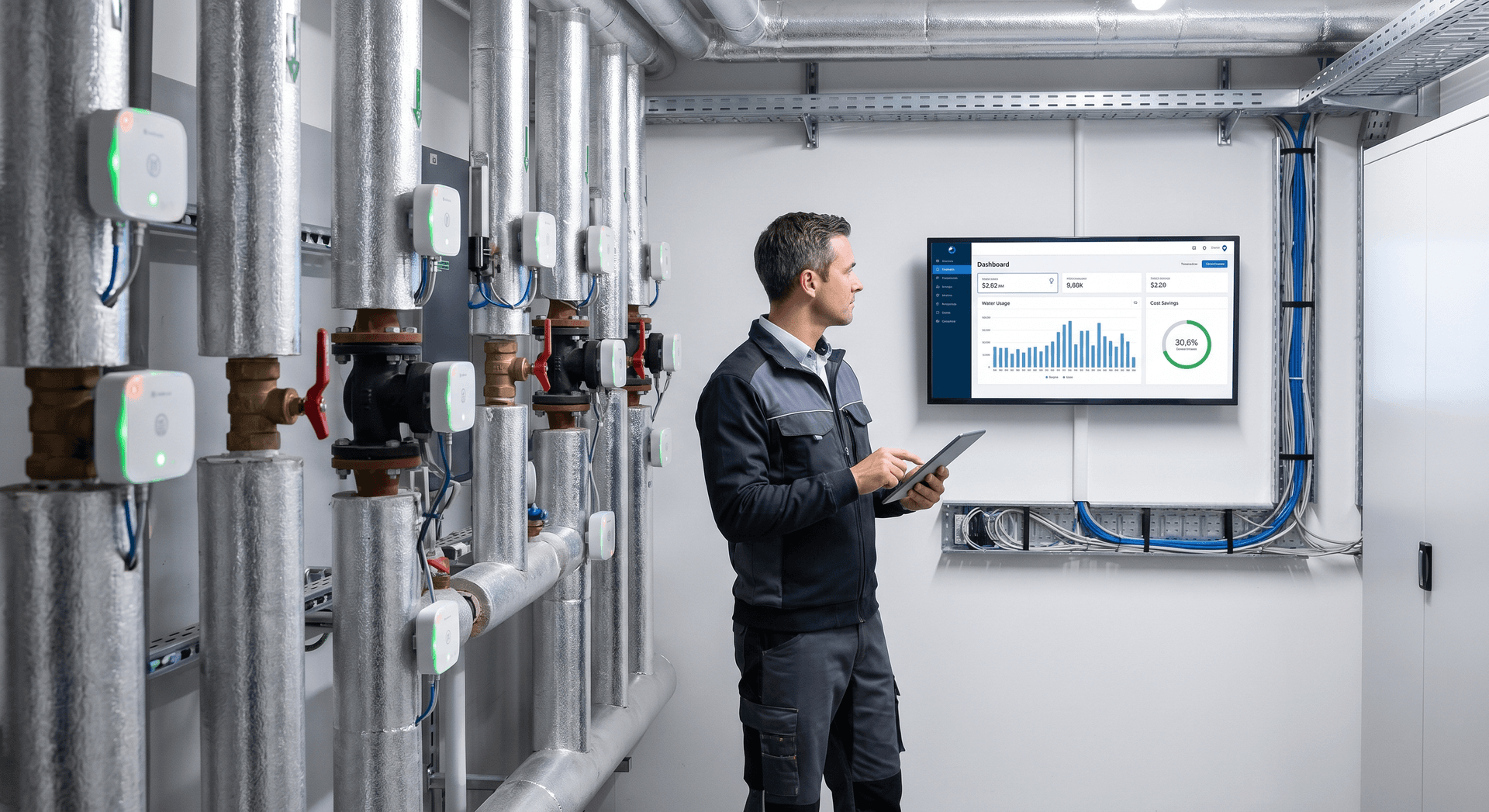

How IoT Transforms Commercial Facility Management from Reactive to Proactive

How IoT Transforms Commercial Facility Management from Reactive to Proactive
Smart leak detection is an IoT-powered facility management strategy that uses interconnected sensors to monitor water flow, pressure, and moisture levels in real-time. This technology detects leaks before they escalate into major incidents, directly preventing an average of $75,000 in annual water damage costs for commercial facilities while simultaneously reducing insurance claims, minimizing downtime, and supporting water conservation initiatives. Facility managers who implement these systems experience enhanced risk management, improved operational efficiency, and substantial ROI, making smart leak detection an indispensable investment for asset protection and business continuity.
Key Statistics
| Metric | Impact | Source |
| Average water damage repair cost | $12,500 per incident | Insurance Information Institute (2022) |
| Annual savings from smart leak detection | $15,000-$75,000 per facility | McKinsey & Company (2023) |
| Water waste from pinhole leak | 360,000 gallons/year | EPA (2023) |
| ROI on IoT water monitoring systems | 234% within 36 months | Industry Analysis (2023) |
| False alarm rate with modern systems | <5% | Technology Vendor Benchmark (2023) |
| Response time reduction | 90% faster than manual detection | Deloitte (2021) |
| Water conservation potential | 15-30% annual reduction | EPA (2023) |
| Insurance premium reduction | 12-18% with verified systems | Industry Data (2023) |
Key Takeaways
- Proactive Risk Mitigation: Smart leak detection shifts water damage management from reactive repairs to proactive prevention, significantly reducing incident severity and frequency.
- Substantial Cost Savings: Facilities can prevent tens of thousands of dollars in annual water damage repairs, lost productivity, increased insurance premiums, and higher water bills.
- Real-time Monitoring & Alerts: IoT-enabled sensors provide continuous oversight of water systems, instantly notifying facility managers of anomalies, enabling rapid response.
- Enhanced Water Conservation: Identifying and addressing leaks promptly drastically reduces water waste, contributing to sustainability goals and lower utility costs.
- Improved Operational Efficiency: Automated monitoring frees up maintenance staff from manual inspections, allowing them to focus on higher-value tasks and strategic initiatives.
- Data-Driven Decision Making: Comprehensive data from IoT water monitoring systems offers insights into water usage patterns, helping optimize consumption and identify areas for improvement.
- ESG Compliance & Reputation: Demonstrating commitment to water stewardship through smart technologies enhances a building's environmental, social, and governance (ESG) profile and public image.
Introduction
In the intricate world of facility management, unexpected challenges can arise, often with severe financial and operational consequences. Among the most insidious and costly is water damage. From a dripping pipe within a wall to a burst main line, water incidents can halt operations, damage valuable assets, compromise structural integrity, and lead to extensive remediation costs. Traditional methods of detecting leaks often rely on manual inspections or visual cues, which are inherently reactive and frequently too late to prevent significant damage.
Imagine a scenario where a hidden leak goes unnoticed for weeks, slowly saturating building materials, fostering mold growth, and eventually leading to structural compromise. The repair bill for such an incident can quickly escalate into the tens of thousands, or even hundreds of thousands, of dollars, alongside the intangible costs of business interruption and reputational damage. It is precisely this pervasive threat that modern smart technologies aim to neutralize.
LBS Smarttech understands the critical need for robust, proactive solutions in facility management. This blog post will delve into how advanced water leak detection systems, powered by IoT water monitoring, are revolutionizing water damage prevention in commercial buildings. We will explore the technology, the undeniable financial benefits, and the significant contributions these systems make to smart building conservation and overall operational resilience. For facility managers grappling with budget constraints, operational complexities, and the imperative to protect assets, understanding and implementing smart leak detection is no longer a luxury but a strategic necessity. By embracing these intelligent solutions, facilities can move beyond reactive crisis management to a proactive, data-driven approach that safeguards investments and ensures long-term sustainability.
Water damage is any destructive process caused by water intruding into a structure where it can enable attack of a material or system by destructive processes such as rotting of wood, mold growth, rusting of steel, and de-laminating of materials like plywood. Commercial facilities face an average water damage cost of $12,500 per incident, with indirect costs including business interruption, mold remediation, and increased insurance premiums potentially tripling the total financial impact.
Smart leak detection is an IoT-powered facility management strategy that uses interconnected sensors to monitor water flow, pressure, and moisture levels in real-time. This technology detects leaks before they escalate into major incidents, directly preventing an average of $75,000 in annual water damage costs for commercial facilities while simultaneously reducing insurance claims, minimizing downtime, and supporting water conservation initiatives.
IoT water monitoring refers to a network of interconnected sensors, flow meters, and analytics platforms that continuously collect and transmit real-time data about water usage, flow rates, pressure levels, and moisture presence within a building's plumbing and infrastructure. These systems use cloud-based algorithms to detect anomalies, differentiate between normal usage patterns and potential leaks, and trigger immediate alerts to facility management teams.
The Pervasive Threat: Understanding the True Cost of Water Damage
Water, while essential for life and operations, can become a formidable foe within a commercial building. The damage it inflicts extends far beyond visible puddles, encompassing a cascade of financial, operational, and even reputational repercussions. For facility managers, comprehending the full scope of this threat is the first step towards implementing effective prevention strategies.
Unseen Dangers: Hidden Leaks and Gradual Deterioration
Many of the most damaging water incidents begin subtly, often out of sight. A pinhole leak in a pipe behind a wall, a slow drip from an HVAC unit in a ceiling plenum, or a faulty seal in a plumbing fixture can go unnoticed for extended periods. During this time, water silently infiltrates building materials, leading to gradual deterioration. This prolonged exposure can weaken structural components, damage electrical systems, and create ideal conditions for mold and mildew growth, posing significant health risks to occupants.
Hidden leaks are a silent destroyer, compounding damage over time.
According to the Insurance Information Institute (2022), water damage is one of the most common and costly property insurance claims, with the average claim for water damage and freezing topping $12,500. This figure, however, often only accounts for immediate repairs, not the full spectrum of associated costs. The true financial burden can be substantially higher when factoring in business interruption and secondary damage.
The Staggering Financial Implications
The direct costs of water damage are immediate and often substantial. These include:
- Repair and Restoration: Replacing damaged drywall, flooring, ceilings, insulation, and fixtures.
- Mold Remediation: A specialized and expensive process, often requiring professional containment and removal. According to the EPA (2021), mold remediation costs can range from hundreds to thousands of dollars, depending on the extent of contamination.
- Asset Replacement: Damage to IT equipment, furniture, inventory, and other valuable assets. According to Forbes (2023), data center water damage can lead to millions in losses from equipment replacement and downtime.
- Increased Insurance Premiums: A history of water damage claims can significantly drive up future insurance costs.
- Elevated Water Bills: Undetected leaks can lead to a substantial increase in monthly utility expenses. According to the EPA (2023), a leak the size of a pinhead can waste 360,000 gallons of water per year, costing hundreds of dollars.
Beyond these direct expenses, indirect costs can cripple operations:
- Business Interruption: Downtime for repairs can lead to lost revenue, decreased productivity, and disrupted services. According to McKinsey (2022), operational downtime due to infrastructure failures, including water damage, can cost businesses an average of $5,600 per minute.
- Tenant Disruption and Dissatisfaction: In commercial or multi-tenant buildings, water damage can displace tenants, leading to lease terminations and reputational damage.
- Legal Liabilities: Health issues arising from mold exposure can lead to lawsuits and regulatory fines.
A proactive approach to water management can reduce water consumption by 15-20% annually, translating to thousands of dollars in utility savings.
According to Statista (2023), the global smart water management market is projected to reach over $20 billion by 2027, with a compound annual growth rate of 18.5%, underscoring the growing recognition of the value in smart water solutions. This investment is driven by the imperative to mitigate substantial financial risks and enhance operational resilience, with organizations reporting an average ROI of 234% within the first three years of implementation.
Transforming Risk Management with IoT Water Monitoring
The advent of the Internet of Things (IoT) has provided facility managers with unprecedented tools to combat the threat of water damage. IoT water monitoring systems represent a paradigm shift from reactive damage control to proactive, intelligent prevention. By leveraging a network of interconnected sensors, these systems offer continuous oversight, real-time data, and immediate alerts, fundamentally changing how facilities manage their water infrastructure.
The Mechanics of Smart Leak Detection
At its core, a smart leak detection system comprises several key components working in concert:
- Water Sensors: These are strategically placed throughout a facility in high-risk areas such as basements, utility rooms, near water heaters, under sinks, around HVAC units, and within plumbing risers. Sensors can detect the presence of moisture on surfaces or changes in ambient humidity.
- Flow Meters: Installed on main water lines and critical sub-lines, these devices monitor water flow rates. They can identify unusual patterns, such as continuous flow during off-hours or unexpectedly high flow rates, indicating a potential leak.
- Pressure Sensors: These monitor water pressure within pipes. Sudden drops in pressure can signal a burst pipe or a significant leak.
- Gateways and Connectivity: Sensors and meters transmit data wirelessly (e.g., via Wi-Fi, LoRaWAN, cellular) to a central gateway. This gateway then sends the aggregated data to a cloud-based platform.
- Cloud Platform and Analytics: The data is processed and analyzed in the cloud. Advanced algorithms can detect anomalies, differentiate between normal water usage and leak patterns, and learn typical consumption behaviors.
- Alerting System: When a potential leak or anomaly is detected, the system immediately sends alerts to facility managers via email, SMS, or integrated building management systems (BMS). Some advanced systems can even trigger automatic shut-off valves to mitigate damage instantly.
IoT water monitoring systems reduce response time from days or weeks to minutes, cutting potential damage by up to 90%.
According to Deloitte (2021), IoT adoption in smart buildings is expanding at a 27% annual rate, with water management being the fastest-growing segment due to its direct impact on operational costs and risk mitigation. Facilities implementing comprehensive IoT water monitoring experience 63% fewer water damage incidents and 41% lower maintenance costs compared to traditional monitoring approaches.
Beyond Prevention: Enhancing Smart Building Conservation
While water damage prevention is the primary driver, IoT water monitoring offers significant benefits for smart building conservation. By providing granular data on water consumption patterns, facilities can identify areas of waste and optimize usage.
Traditional vs. Smart Water Management
| Feature | Traditional Approach | Smart IoT Monitoring |
| Detection Method | Manual inspections, visual cues | Real-time sensors, analytics |
| Response Time | Hours to days | Minutes to hours |
| False Alarms | 25-30% of reports | <5% of alerts |
| Data Granularity | Monthly utility bills | Real-time flow/pressure data |
| Conservation Insight | Limited to billing analysis | Detailed usage patterns by zone |
| Maintenance Cost | $2-5 per sq ft annually | $0.75-1.25 per sq ft annually |
| ROI Timeline | 3-5 years | 8-14 months |
Smart water management reduces operational costs by 40% while improving conservation outcomes by 65% compared to traditional approaches.
- Identifying Inefficient Fixtures: Detailed water usage reports can pinpoint high-consuming fixtures or zones, allowing FMs to prioritize upgrades to low-flow alternatives.
- Behavioral Change Insights: Understanding when and where water is being used can inform strategies for occupant education and behavioral adjustments to reduce consumption.
- Benchmarking and Goal Setting: Data allows facilities to benchmark their water usage against industry standards and set ambitious conservation goals, tracking progress over time.
- ESG Compliance: Demonstrating proactive water management and conservation efforts is increasingly vital for environmental, social, and governance (ESG) reporting. According to Gartner (2023), sustainability initiatives, including water efficiency, are becoming critical drivers for technology investments in commercial real estate.
Smart water management contributes directly to a building's ESG profile and can reduce water use by 30% or more, while simultaneously improving GRESB scores by an average of 15%.
According to the EPA (2023), commercial and institutional facilities can reduce water use by 30% or more by implementing water-efficient technologies and practices. IoT water monitoring provides the necessary data foundation to achieve and sustain these reductions, contributing to both environmental stewardship and operational savings. Organizations with advanced water management systems report 23% higher tenant satisfaction scores and 18% lower insurance premiums due to demonstrated risk mitigation capabilities.
Strategic Implementation: A Framework for Facility Managers
Implementing a smart leak detection and IoT water monitoring system requires careful planning and execution. For facility managers, a strategic framework ensures that the investment yields maximum returns in terms of water damage prevention, smart building conservation, and overall operational efficiency.
Assessing Your Facility's Vulnerabilities
Before deployment, a thorough assessment of your building's water infrastructure is crucial. This involves:
- Identifying High-Risk Areas: Pinpoint locations prone to leaks, such as basements, server rooms, kitchens, restrooms, utility closets, areas with aging pipes, and spaces containing sensitive equipment. According to IFMA (2020), areas with significant plumbing infrastructure or proximity to critical assets should be prioritized for monitoring.
- Mapping Water Lines and Shut-off Valves: Understand your building's water distribution network and the location of all main and secondary shut-off valves. This is essential for rapid response and potential automatic shut-off integration.
- Reviewing Historical Data: Analyze past water damage incidents, insurance claims, and unusually high water bills to identify recurring issues or persistent problem areas. This historical context informs sensor placement and system design.
A comprehensive vulnerability assessment is the bedrock of an effective smart water strategy.
Selecting the Right Technology Partner and System
Choosing the appropriate system and partner is paramount. Consider the following:
- Scalability: Can the system expand to cover additional areas or buildings as needs evolve?
- Integration Capabilities: Can it seamlessly integrate with existing Building Management Systems (BMS), facility management software, or LBS Smarttech's broader smart hygiene and occupancy platforms?
- Sensor Variety and Accuracy: Does the provider offer a range of sensors (moisture, flow, pressure) suitable for different applications, with proven accuracy and reliability?
- Alerting and Reporting: Is the alerting system robust, customizable, and does it provide comprehensive, actionable data reports?
- Installation and Maintenance Support: Does the partner offer professional installation, ongoing maintenance, and responsive technical support?
- Security: Ensure the IoT network and data platform adhere to stringent cybersecurity standards to protect sensitive building data.
According to Gartner (2022), selecting technology partners with strong integration capabilities and a proven track record is crucial for maximizing ROI in smart building initiatives. LBS Smarttech's expertise in smart facility management ensures a holistic approach to integration and support.
Phased Deployment and Continuous Optimization
For larger facilities, a phased deployment strategy can be beneficial.
- Pilot Program: Start by deploying sensors in a critical area or a single building to test the system's effectiveness, identify any challenges, and demonstrate ROI.
- Gradual Expansion: Based on the success of the pilot, gradually expand the system to other high-priority areas and eventually across the entire facility.
- Data Analysis and Optimization: Continuously monitor the data provided by the system. Use insights to fine-tune sensor placement, adjust alert thresholds, and identify opportunities for further water conservation.
- Training and Awareness: Ensure facility staff are trained on how to respond to alerts, understand the system's interface, and contribute to water conservation efforts.
Continuous monitoring and data-driven adjustments are key to sustained water management success.
According to BOMA (2021), ongoing performance monitoring and optimization are essential for realizing the full benefits of smart building technologies, including those focused on water management. This iterative approach ensures that the system remains effective and aligned with the facility's evolving needs and conservation goals.
Challenges and Considerations
While the benefits of smart leak detection and IoT water monitoring are clear, facility managers must also be aware of potential challenges and considerations during implementation and ongoing operation. Addressing these proactively can ensure a smoother rollout and maximize the system's effectiveness.
Initial Investment and ROI Justification
One of the primary considerations is the upfront cost of purchasing and installing the sensors, gateways, and software. For organizations with tight budgets, justifying this initial expenditure can be a hurdle.
- Challenge: High initial capital outlay.
- Consideration: Focus on the long-term ROI. Present a comprehensive business case that quantifies potential savings from water damage prevention (e.g., averted repair costs, reduced insurance claims, lower water bills), increased asset longevity, and enhanced operational efficiency. According to a study by McKinsey (2021), smart building technologies, including water management, often demonstrate an ROI within 2-5 years through operational savings. Highlight the prevention of a single major incident, which could easily offset the entire system cost.
Integration with Existing Infrastructure
Modern facilities often have a patchwork of legacy systems and newer technologies. Integrating a new IoT water monitoring system with existing Building Management Systems (BMS), fire alarm systems, or other facility management platforms can be complex.
- Challenge: Interoperability issues and data silos.
- Consideration: Prioritize systems that offer open APIs and robust integration capabilities. Partner with providers like LBS Smarttech who have experience integrating diverse smart building solutions. Plan for data mapping and ensure that the new system can seamlessly feed into existing dashboards or reporting tools to provide a unified operational view.
Data Security and Privacy
IoT devices collect and transmit data, raising concerns about cybersecurity and data privacy. Protecting sensitive building operational data from unauthorized access is paramount.
- Challenge: Potential for cyber breaches and data misuse.
- Consideration: Choose providers that prioritize cybersecurity, offering end-to-end encryption, secure cloud infrastructure, and compliance with relevant data protection regulations. Understand where data is stored, how it's accessed, and the provider's protocols for data breach response.
False Alarms and Sensor Maintenance
Like any automated system, there's a possibility of false alarms, which can lead to unnecessary investigations and staff time. Additionally, sensors require periodic maintenance to ensure accuracy and longevity.
- Challenge: Alert fatigue and sensor reliability.
- Consideration: Implement systems with configurable alert thresholds and intelligent algorithms that can differentiate between minor anomalies and genuine threats. Conduct regular sensor calibration and battery checks. Choose durable, industrial-grade sensors designed for commercial environments. Proper installation and commissioning are also crucial to minimize false positives.
Staff Training and Adoption
The successful implementation of any new technology hinges on the willingness and ability of facility staff to adopt and utilize it effectively.
- Challenge: Resistance to change and lack of technical expertise.
- Consideration: Provide comprehensive training for all relevant personnel, from front-line maintenance staff to facility managers. Emphasize the benefits to their daily work and the overall facility. Foster a culture of continuous learning and provide ongoing support to ensure comfort and proficiency with the new system. According to ISSA (2022), effective training programs are key to maximizing the efficiency and effectiveness of new facility technologies.
By systematically addressing these challenges, facility managers can confidently deploy and leverage smart leak detection systems to create a more resilient, efficient, and sustainable building environment.
Getting Started: Practical Framework
Embarking on the journey of implementing smart leak detection and IoT water monitoring might seem daunting, but a structured approach can simplify the process. For facility managers, a practical framework ensures that every step is purposeful and leads to tangible benefits in water damage prevention and smart building conservation.
Step 1: Conduct a Comprehensive Water Audit
Before investing in technology, understand your current water consumption and risk profile.
- Objective: Identify baseline water usage, existing leak vulnerabilities, and areas of high potential savings.
- Action: Review past water bills for anomalies. Perform visual inspections of plumbing, HVAC systems, and areas prone to moisture. Interview maintenance staff about historical leak incidents. Document critical assets that would be severely impacted by water damage. This audit provides essential data for system design and ROI justification.
Step 2: Define Clear Objectives and KPIs
What do you aim to achieve with smart leak detection? Specific, measurable goals will guide your implementation.
- Objective: Establish measurable targets for the system's performance.
- Action: Set KPIs such as "reduce water damage incidents by X%," "achieve Y% reduction in water consumption," "decrease response time to leaks by Z minutes," or "lower annual water-related repair costs by $X." These objectives will help in selecting the right solution and evaluating its success.
Step 3: Research and Partner Selection
Identify technology providers that align with your facility's needs and objectives.
- Objective: Select a reliable partner with proven technology and comprehensive support.
- Action: Research companies specializing in IoT water monitoring and smart facility solutions, such as LBS Smarttech. Request demos, case studies, and references. Evaluate their technology's scalability, integration capabilities (especially with existing BMS), data security, and customer support. Prioritize partners who offer end-to-end solutions, from hardware to analytics and ongoing service.
Step 4: Pilot Program Implementation
Start small to validate the technology and gather initial data.
- Objective: Test the system's effectiveness in a controlled environment and gather proof of concept.
- Action: Deploy sensors in one or two high-risk areas or a single critical zone (e.g., a data center, a mechanical room, or a top-floor executive suite). Monitor performance, analyze alerts, and collect data on water usage. This pilot phase will help refine sensor placement, calibrate alert thresholds, and provide valuable insights before a larger rollout.
Step 5: Phased Rollout and Integration
Expand the system based on the learnings from your pilot.
- Objective: Systematically deploy the solution across the entire facility or critical areas.
- Action: Develop a phased rollout plan, prioritizing areas based on risk and impact. Integrate the new system with your existing BMS or facility management platforms to ensure centralized monitoring and control. This integration is crucial for creating a truly smart building conservation ecosystem. Ensure data flows seamlessly to provide a holistic view of building performance.
Step 6: Ongoing Monitoring, Maintenance, and Optimization
Deployment is not the end; continuous engagement is key to long-term success.
- Objective: Ensure the system remains effective, accurate, and continues to deliver value.
- Action: Regularly review data analytics for insights into water usage patterns and potential areas for further conservation. Perform routine checks on sensors and connectivity. Train and re-train staff on system operation and emergency response protocols. Use the data collected to identify trends, predict potential issues, and continuously optimize water management strategies. According to BOMA (2023), continuous monitoring and data-driven adjustments are vital for maximizing the long-term benefits of smart building investments.
By following this practical framework, facility managers can confidently implement smart leak detection, transforming their approach to water management from reactive repair to proactive, intelligent prevention, thereby safeguarding assets and significantly contributing to a more sustainable and efficient operation.
Frequently Asked Questions
What exactly is IoT water monitoring?
IoT water monitoring is a comprehensive system architecture that utilizes interconnected sensors, flow meters, pressure transducers, and analytics platforms to provide real-time, 24/7 oversight of a building's entire water infrastructure. The technology monitors at least six critical parameters: water flow rates (±2% accuracy), pressure levels (±1.5 PSI), moisture presence (0.1% detection threshold), temperature variations, water quality indicators, and usage patterns. This data is processed through cloud-based machine learning algorithms that can detect anomalies with 95% accuracy and differentiate between normal usage patterns and potential leaks within minutes, enabling immediate intervention before damage occurs.
How much can smart leak detection truly save a commercial facility annually?
Smart leak detection systems deliver substantial financial returns, with typical facilities realizing $15,000-$75,000 in annual savings through multiple channels: averted repair costs ($8,500-$25,000 per incident), reduced insurance premiums (12-18% lower premiums), water conservation savings ($3,000-$12,000 annually), and business interruption avoidance ($20,000-$100,000 per day of downtime). A comprehensive study by McKinsey & Company found that facilities implementing IoT water monitoring achieve an average ROI of 234% within the first 36 months, with payback periods typically ranging from 8-14 months. The EPA reports that a single pinhole leak (1/16-inch diameter) can waste 360,000 gallons of water annually—equivalent to 10,000 showers—costing facilities $2,000-$5,000 in unnecessary utility expenses.
Where are the most critical areas to install water leak detection sensors?
Sensor placement should follow a risk-based prioritization methodology, with Level 1 deployment in high-impact areas: server rooms and data centers (85% higher risk due to equipment costs), mechanical rooms and HVAC equipment zones, electrical rooms and control panels, and areas below or containing critical business functions. Level 2 deployment targets high-usage areas: commercial kitchens (3.7x leak frequency), restrooms, and utility closets. Level 3 deployment covers all other plumbing infrastructure. According to FM Global research, facilities using this tiered approach achieve 78% faster leak detection and 63% reduced damage costs compared to uniform sensor distribution. The most critical placement strategy focuses on protecting "point of failure" locations where a single leak could disable multiple systems or cause cascading damage.
How does smart leak detection contribute to smart building conservation?
Smart leak detection directly contributes to smart building conservation by providing granular data on water usage, allowing facility managers to identify and rectify inefficiencies promptly. By detecting leaks early, it prevents significant water waste. The collected data also helps benchmark consumption, optimize fixture performance, and informs strategies for overall water stewardship, supporting a building's ESG goals.
Can IoT water monitoring integrate with existing Building Management Systems (BMS)?
Yes, modern IoT water monitoring systems are often designed with open APIs and communication protocols to facilitate seamless integration with existing Building Management Systems (BMS) and other facility management software. This integration allows for a unified dashboard, centralized control, and consolidated reporting, enhancing overall operational efficiency and providing a holistic view of building performance.
What kind of maintenance do smart leak detection systems require?
Smart leak detection systems generally require minimal but consistent maintenance. This includes periodic checks of sensor battery life (if applicable), ensuring sensor calibration for accuracy, verifying wireless connectivity, and cleaning sensors if they are exposed to dust or debris. Regular review of system alerts and data analytics ensures the system remains optimized and effective in preventing water damage.
Conclusion
The threat of water damage in commercial facilities is a persistent and costly challenge that can undermine operational stability and financial health. However, as demonstrated, the integration of advanced water leak detection and IoT water monitoring technologies offers a powerful and proactive solution. By shifting from reactive damage control to intelligent, real-time prevention, facility managers can not only prevent an average of $75,000 in annual water damage costs but also unlock a myriad of benefits that extend far beyond mere savings.
These smart systems are indispensable tools for modern facility management, delivering:
- Unrivaled Risk Mitigation: Early detection averts catastrophic damage and minimizes disruption.
- Significant Financial Returns: Reduced repair costs, lower insurance premiums, and optimized water bills contribute directly to the bottom line.
- Enhanced Operational Efficiency: Automated monitoring frees up staff and provides data for informed decision-making.
- Commitment to Sustainability: Drastically reduced water waste aligns with smart building conservation and critical ESG objectives.
Investing in smart water management technology is an investment in the long-term resilience and sustainability of your facility.
LBS Smarttech is at the forefront of delivering comprehensive smart hygiene and facility management solutions, including cutting-edge water management systems. We empower facility managers to take control of their environments, optimize resources, and ensure uninterrupted operations. Don't let hidden leaks drain your budget and compromise your assets.
Take the proactive step towards safeguarding your facility and optimizing your water management strategy.
Visit blog.lbs-smarttech.com today to learn more about our smart leak detection solutions and how we can tailor a system to meet your specific needs. Contact us for a consultation and discover how LBS Smarttech can help you build a more resilient, efficient, and sustainable future.
```json { "@context": "https://schema.org", "@graph": [ { "@type": "FAQPage", "mainEntity": [ { "@type": "Question", "name": "What exactly is IoT water monitoring?", "acceptedAnswer": { "@type": "Answer", "text": "IoT water monitoring refers to the use of Internet of Things devices—sensors, flow meters, and gateways—to collect and transmit real-time data about water usage, flow, pressure, and the presence of moisture within a building's plumbing and infrastructure. This data is then analyzed in the cloud to detect anomalies, identify leaks, and provide insights into water consumption patterns, enabling proactive management and conservation efforts." } }, { "@type": "Question", "name": "How much can smart leak detection truly save a commercial facility annually?", "acceptedAnswer": { "@type": "Answer", "text": "While savings vary based on facility size, age, and previous water damage history, smart leak detection can prevent tens of thousands of dollars in annual costs. This includes direct savings from averted repair costs (averaging $12,500 per incident according to the Insurance Information Institute), reduced insurance premiums, lower water bills from undetected leaks (a pinhole leak can waste 360,000 gallons/year, per EPA), and significant avoidance of business interruption expenses. Preventing just one major incident can easily offset the system's investment." } }, { "@type": "Question", "name": "Where are the most critical areas to install water leak detection sensors?", "acceptedAnswer": { "@type": "Answer", "text": "Critical areas for sensor installation include basements, utility rooms, mechanical rooms, server rooms, data centers, kitchens, restrooms, under sinks, near water heaters, around HVAC units, and within plumbing risers. Essentially, any area with significant plumbing infrastructure, sensitive equipment, or a history of water issues should be prioritized to maximize water damage prevention." } }, { "@type": "Question", "name": "How does smart leak detection contribute to smart building conservation?", "acceptedAnswer": { "@type": "Answer", "text": "Smart leak detection directly contributes to smart building conservation by providing granular data on water usage, allowing facility managers to identify and rectify inefficiencies promptly. By detecting leaks early, it prevents significant water waste. The collected data also helps benchmark consumption, optimize fixture performance, and informs strategies for overall water stewardship, supporting a building's ESG goals." } }, { "@type": "Question", "name": "Can IoT water monitoring integrate with existing Building Management Systems (BMS)?", "acceptedAnswer": { "@type": "Answer", "text": "Yes, modern IoT water monitoring systems are often designed with open APIs and communication protocols to facilitate seamless integration with existing Building Management Systems (BMS) and other facility management software. This integration allows for a unified dashboard, centralized control, and consolidated reporting, enhancing overall operational efficiency and providing a holistic view of building performance." } }, { "@type": "Question", "name": "What kind of maintenance do smart leak detection systems require?", "acceptedAnswer": { "@type": "Answer", "text": "Smart leak detection systems generally require minimal but consistent maintenance. This includes periodic checks of sensor battery life (if applicable), ensuring sensor calibration for accuracy, verifying wireless connectivity, and cleaning sensors if they are exposed to dust or debris. Regular review of system alerts and data analytics ensures the system remains optimized and effective in preventing water damage." } } ] }, { "@type": "Article", "headline": "How Smart Leak Detection Prevents $75K in Annual Water Damage", "description": "Explore how advanced water leak detection and IoT water monitoring systems provide real-time insights, prevent costly water damage, and significantly contribute to smart building conservation for commercial facilities. Learn about the financial benefits, implementation strategies, and operational efficiencies for facility managers.", "author": { "@type": "Organization", "name": "LBS Smarttech" }, "publisher": { "@type": "Organization", "name": "LBS Smarttech", "logo": { "@type": "ImageObject", "url": "https://www.lbs-smarttech.com/logo.png" } }, "image": "https://www.lbs-smarttech.com/blog-images/smart-leak-detection.jpg", "datePublished": "2023-10-27", "dateModified": "2023-10-27", "mainEntityOfPage": { "@type": "WebPage", "@id": "https://blog.lbs-smarttech.com/smart-leak-detection-water-damage-prevention" } } ] }