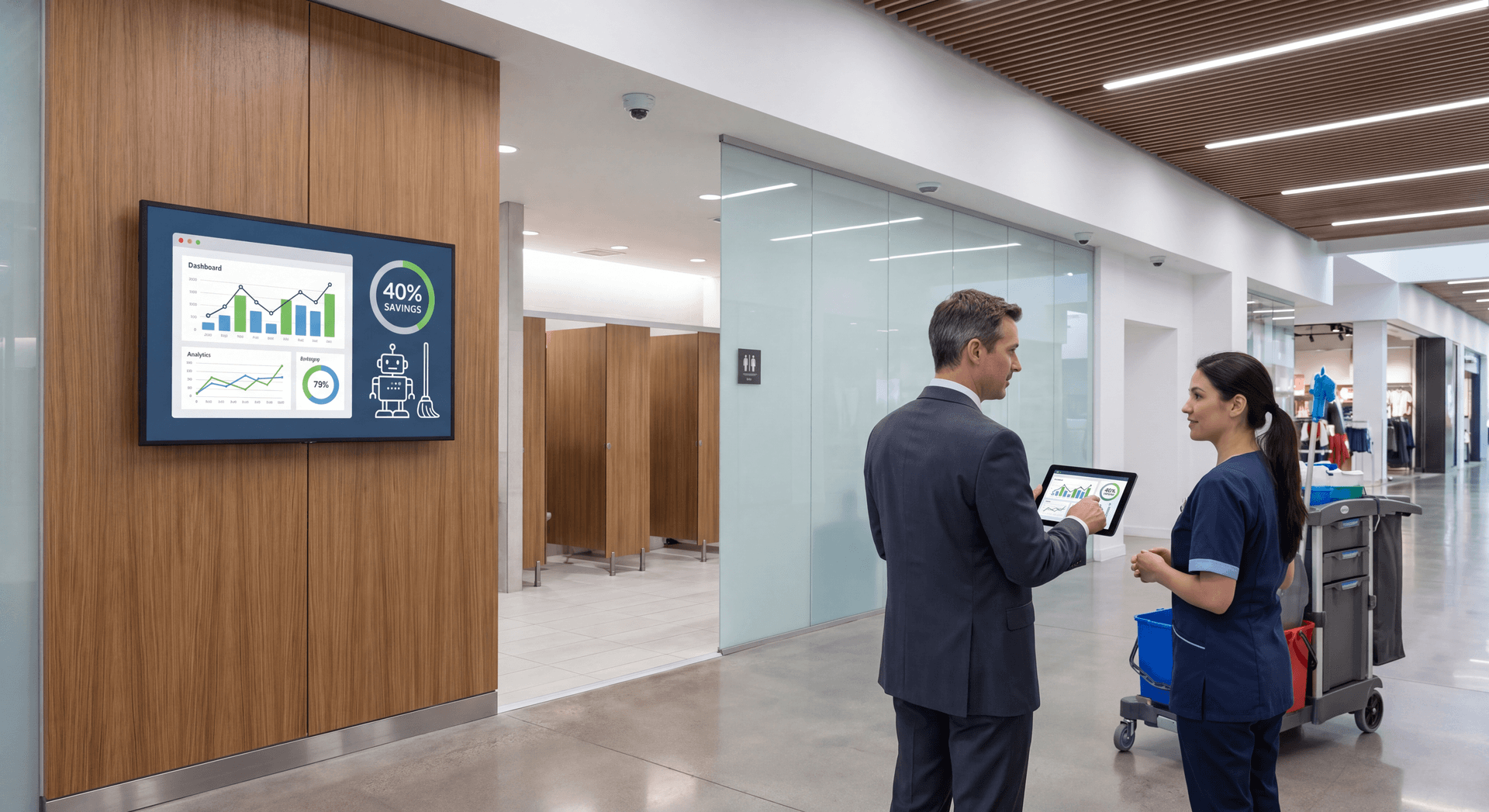

How Occupancy Analytics Is Transforming Commercial Cleaning: From Fixed Schedules to Demand-Driven Maintenance
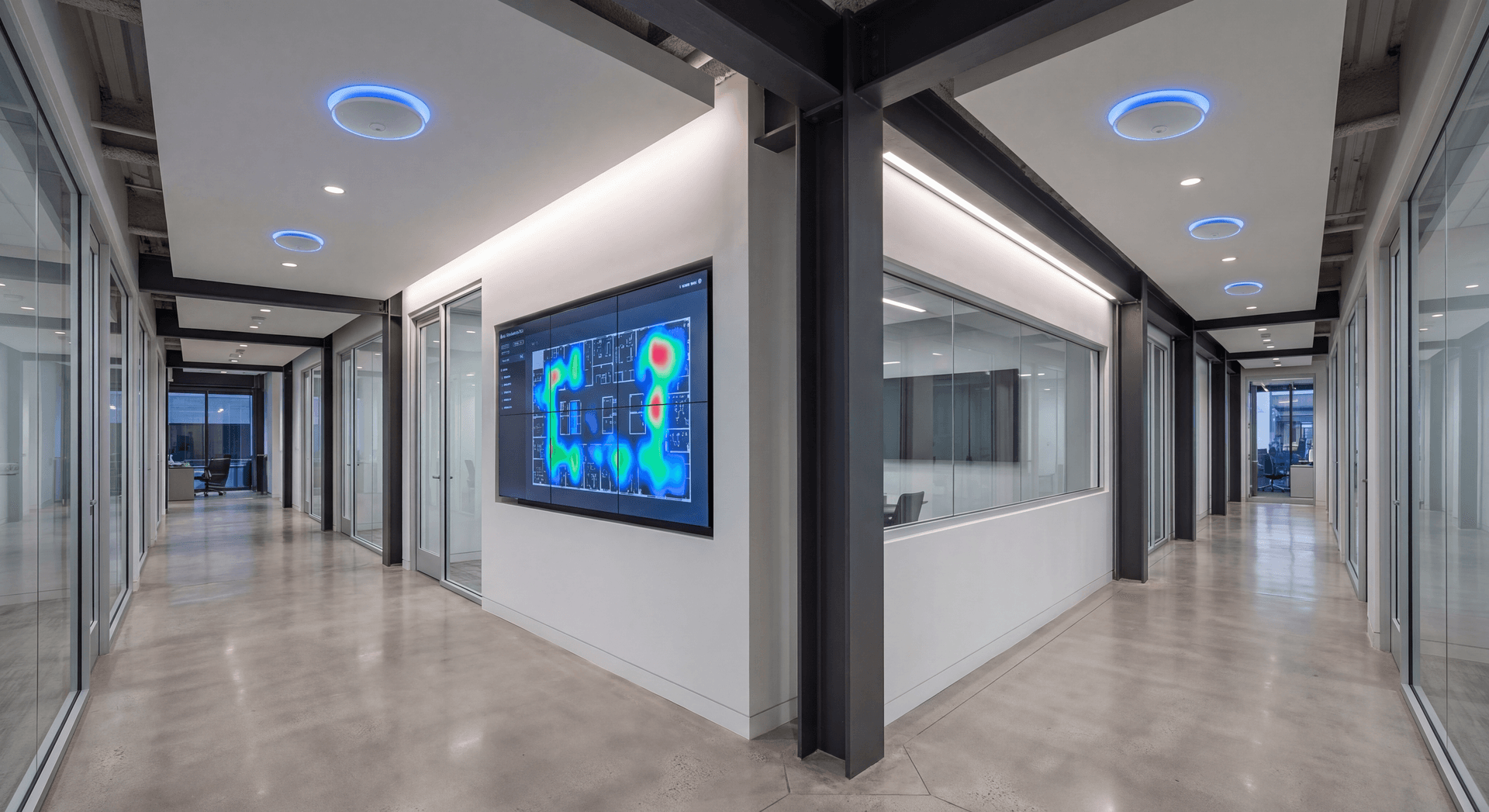
How Occupancy Analytics Is Transforming Commercial Cleaning: From Fixed Schedules to Demand-Driven Maintenance
Direct Answer
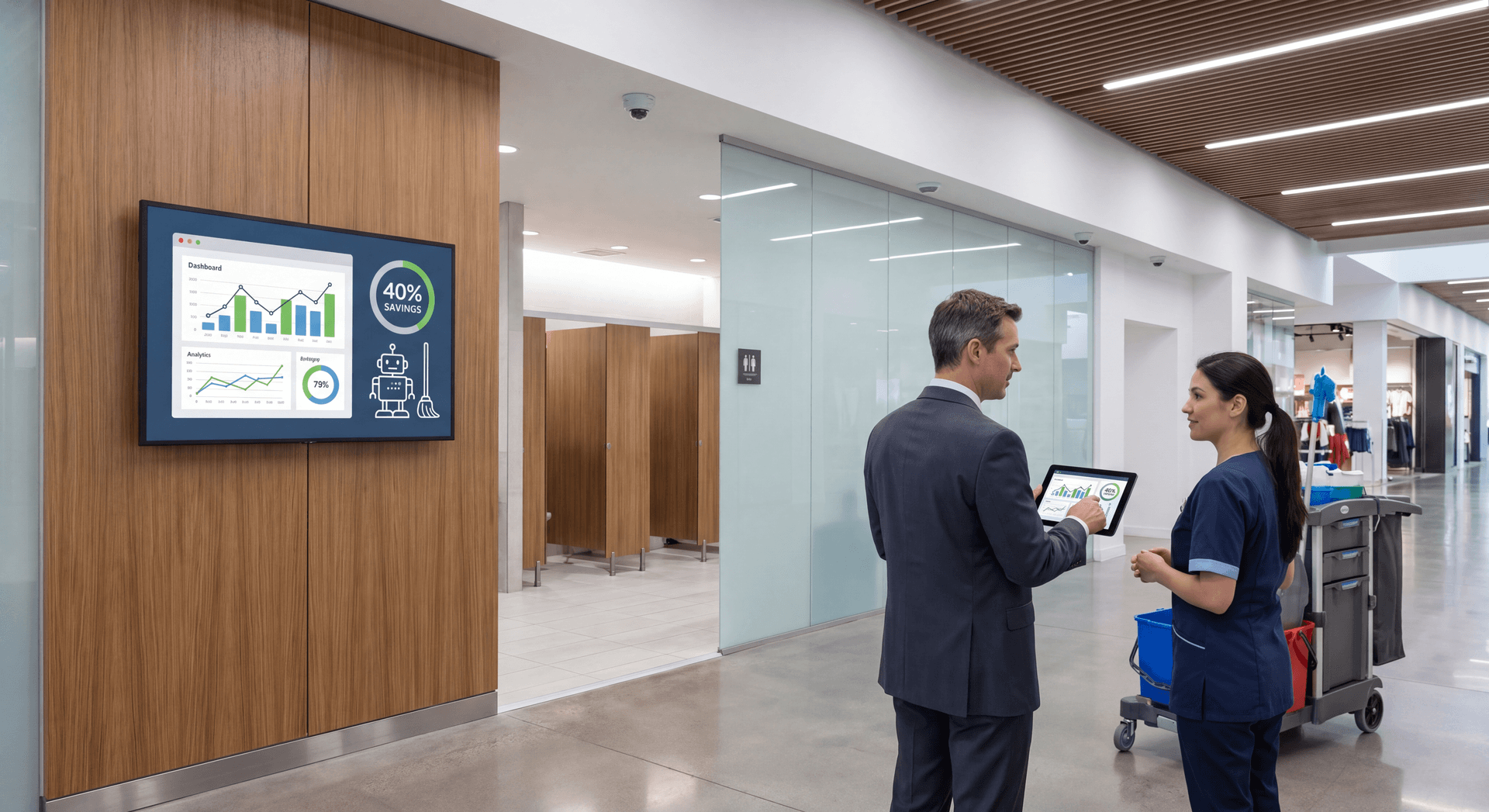
Occupancy analytics uses IoT sensors and smart building technology to track real-time restroom and facility usage, enabling cleaning teams to respond to actual demand rather than rigid schedules. Commercial buildings that have adopted demand-driven cleaning report up to 40% reduction in unnecessary cleaning visits, 30% lower supply costs, and significantly higher occupant satisfaction scores. By shifting from time-based to usage-based maintenance, facility managers optimize labor allocation, reduce waste, and deliver cleaner spaces with fewer resources — making occupancy analytics one of the highest-ROI smart building investments available in 2026.
Key Takeaways
- Occupancy analytics replaces fixed cleaning schedules with real-time, usage-based task prioritization
- Buildings using demand-driven cleaning reduce unnecessary cleaning visits by up to 40%
- IoT occupancy sensors cost as little as $50–$150 per unit with 3–5 year battery life
- Occupant satisfaction scores improve by 25–35% when cleaning matches actual usage patterns
- The global smart building occupancy analytics market is projected to reach $6.8 billion by 2028
- ROI is typically achieved within 6–12 months of deployment
- Demand-driven cleaning reduces cleaning supply waste by 20–30%
- Integration with existing BMS and CAFM platforms is seamless via open APIs
The Problem with Fixed Cleaning Schedules
For decades, commercial buildings have relied on fixed cleaning schedules — predefined intervals where janitorial staff service restrooms, common areas, and workspaces regardless of actual usage. A restroom in a busy office lobby might receive the same cleaning frequency as one on a seldom-used executive floor. This one-size-fits-all approach creates two costly problems.
First, over-servicing wastes resources. Cleaning teams spend time and supplies on spaces that don't need attention, driving up labor costs and chemical usage. Studies show that in buildings with fixed schedules, up to 40% of cleaning visits are unnecessary, representing thousands of wasted labor hours annually across a multi-site portfolio.
Second, under-servicing damages tenant satisfaction and brand perception. A high-traffic restroom that isn't cleaned often enough quickly becomes a source of complaints, negative reviews, and lease renewal hesitations. According to a 2025 IFMA survey, restroom cleanliness remains the number-one driver of overall building satisfaction, with 68% of tenants citing it as their top facility concern.
The fundamental flaw is information asymmetry: facility managers simply don't know which spaces need attention and which don't. Occupancy analytics eliminates this blind spot entirely.
What Is Occupancy Analytics?
Occupancy analytics refers to the collection, processing, and interpretation of real-time data about how people use physical spaces. In the context of commercial cleaning, it involves deploying IoT sensors — typically passive infrared (PIR), time-of-flight (ToF), or camera-free people counters — at restroom entrances, corridor junctions, and key facility touchpoints.
These sensors continuously monitor foot traffic, dwell times, and usage patterns without capturing personally identifiable information. The data feeds into a centralized facility management platform that translates raw counts into actionable cleaning triggers.
For example, when a restroom's visit counter exceeds a configurable threshold — say, 50 visits since the last cleaning — the system automatically generates a task for the janitorial team. Conversely, if a restroom on a quiet floor has only seen 5 visits, the system deprioritizes it, freeing staff to focus on higher-need areas.
Modern occupancy analytics platforms go beyond simple counting. They incorporate:
- Historical trend analysis to predict peak usage periods and pre-position cleaning resources
- Multi-zone correlation to understand traffic flow patterns across an entire building
- Anomaly detection to flag unexpected usage spikes that may indicate events, leaks, or maintenance issues
- Integration APIs that connect with CAFM, CMMS, and building management systems for end-to-end workflow automation
The Technology Stack Behind Demand-Driven Cleaning
Deploying occupancy analytics for cleaning optimization requires three core components:
1. IoT Occupancy Sensors
Today's commercial-grade occupancy sensors are compact, wireless, and remarkably energy-efficient. Leading models from vendors like Terabee, Irisys, and Xovis offer:
- Battery life of 3–5 years on a single cell
- Accuracy rates above 98% for people counting
- Privacy-by-design operation (no cameras, no facial recognition)
- Ceiling or wall mounting with minimal installation disruption
- Unit costs between $50 and $150 depending on features and volume
For LBS Smarttech's deployment scenarios across Hong Kong and Southeast Asia, these sensors operate reliably in humid, high-traffic environments and integrate seamlessly with existing building infrastructure.
2. Edge Processing and Cloud Analytics
Raw sensor data is processed at the edge (on-device or via local gateways) to reduce bandwidth consumption and latency. Aggregated usage metrics are then transmitted to a cloud analytics platform that applies machine learning models to:
- Classify usage patterns by time of day, day of week, and season
- Generate predictive cleaning schedules based on historical trends
- Calculate cleaning efficiency KPIs such as cost-per-visit and occupant-to-clean ratio
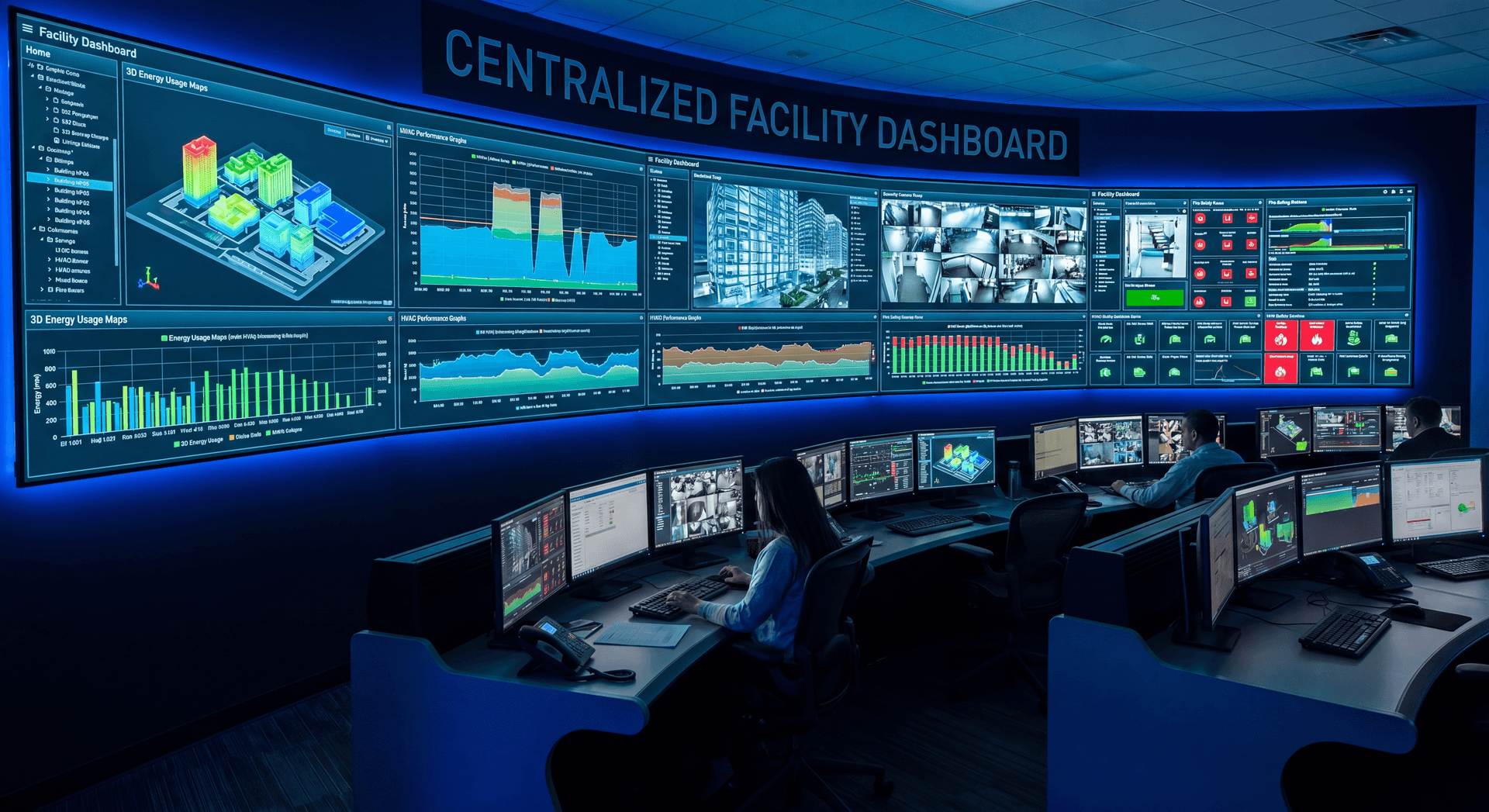
- Produce real-time dashboards for facility managers and building owners
Edge processing ensures that occupancy analytics systems remain responsive even during network disruptions — a critical requirement for mission-critical facilities like hospitals and airports.
3. Task Dispatch and Workflow Automation
The final component is the task management layer that converts analytics insights into janitorial action. When the system determines that a space requires cleaning, it:
- Generates a prioritized task ticket with location, urgency level, and estimated effort
- Dispatches the task to the nearest available cleaning operative via mobile app
- Tracks task completion with timestamped confirmation
- Updates the analytics baseline to refine future predictions
This closed-loop system ensures that no space falls through the cracks while eliminating redundant cleaning visits.
Real-World Results: Case Data from Deployments
The impact of occupancy-driven cleaning is not theoretical. Multiple real-world deployments demonstrate consistent, measurable results:
- A 1.2 million sq ft commercial complex in Singapore reduced cleaning labor hours by 35% within six months of deploying occupancy analytics, while occupant satisfaction scores rose from 3.6 to 4.4 out of 5.0.
- A chain of 200+ quick-service restaurants in Japan cut paper towel and soap refill costs by 28% by aligning supply restocking with actual restroom traffic rather than fixed schedules.
- A Grade A office tower in Hong Kong achieved full ROI on its occupancy sensor investment within 9 months, primarily through reduced outsourced cleaning contract costs. The building's NABERS rating also improved by one star due to documented efficiency gains.
- A university campus in Australia with 120 restrooms eliminated restroom-related complaints by 72% after implementing demand-driven cleaning, reducing the facilities team's reactive workload significantly.
These results are consistent across building types and geographies, confirming that occupancy analytics delivers universal value wherever cleaning is scheduled on a fixed basis.
Cost-Benefit Analysis
For facility managers evaluating occupancy analytics, the financial case is compelling:
Investment:
- Sensors: $50–$150 per restroom entrance (typical deployment: 2–4 sensors per restroom)
- Platform subscription: $2–$8 per sensor per month, depending on analytics depth
- Installation and commissioning: $100–$300 per restroom for a typical retrofit
- Training and change management: $2,000–$5,000 per site
Returns:
- Labor cost reduction: 25–35% of cleaning budget
- Supply waste reduction: 20–30%
- Complaint resolution cost avoidance: significant but harder to quantify
- Tenant retention improvement: estimated 5–10% reduction in turnover-related costs
For a mid-sized commercial building with 50 restrooms, the total investment typically ranges from $15,000 to $35,000, with annual savings of $40,000 to $80,000 — yielding a payback period of 4–10 months.
Privacy and Compliance Considerations
One of the most common concerns about occupancy monitoring is privacy. Facility managers and building occupants understandably want assurance that usage tracking doesn't compromise personal privacy.
Modern occupancy analytics platforms address this through:
- Camera-free operation using PIR, thermal, or time-of-flight sensors that detect presence without capturing images
- Aggregated data only — systems count entries and exits without tracking individual identities
- GDPR and PDPA compliance by design, with no personally identifiable information collected or stored
- Transparent signage informing occupants that anonymized usage monitoring is in place
- Data retention policies that automatically purge granular data after configurable periods
In Hong Kong, occupancy analytics for facility management purposes falls well within the Personal Data (Privacy) Ordinance requirements, provided no identifiable data is collected — which is standard practice across all major sensor vendors.
Integration with Existing Systems
Occupancy analytics doesn't exist in isolation. Its value multiplies when integrated with other smart building systems:
- CAFM/CMMS platforms: Automatic work order generation in systems like Maximo, Planon, or UpKeep
- BMS/BAS: Correlating HVAC usage with occupancy to optimize energy consumption alongside cleaning schedules
- Digital signage: Displaying real-time restroom availability to building occupants, reducing congestion and improving flow
- ESG reporting platforms: Documenting resource efficiency gains for sustainability disclosures and green building certifications
- Access control systems: Cross-referencing badge data with occupancy counts to validate usage models
Open API architectures ensure that occupancy analytics platforms can communicate bi-directionally with the broader building technology ecosystem, creating a unified smart facility management layer.
The Future: AI-Driven Predictive Cleaning
While today's occupancy analytics platforms are largely reactive — responding to current usage patterns — the next generation is predictive. Machine learning models trained on months or years of occupancy data can forecast cleaning needs before they arise.
For example, a predictive system might learn that a particular office building experiences a restroom usage spike every second Wednesday due to a recurring client meeting. Instead of waiting for the usage threshold to trigger a task, the system pre-schedules cleaning for those periods, ensuring the restroom is always ready before demand peaks.
Early adopters of predictive cleaning analytics report an additional 10–15% efficiency gain on top of the savings from reactive demand-driven cleaning, suggesting that the technology's full potential is still being realized.
Why 2026 Is the Tipping Point
Several converging trends make 2026 the ideal time for commercial buildings to adopt occupancy analytics for cleaning:
- Sensor costs have dropped 60% since 2020, making deployments financially viable even for mid-market buildings
- Battery technology improvements now support 5-year sensor lifespans, reducing maintenance overhead
- Cloud analytics platforms have matured, offering turnkey solutions that don't require in-house data science teams
- ESG and green building certification programs increasingly reward documented resource efficiency
- Labor shortages in cleaning services across Asia-Pacific make optimization not just desirable but necessary
According to a 2026 CBRE Asia Pacific Facilities Management report, 62% of institutional landlords now consider smart cleaning technology a "must-have" rather than a "nice-to-have" in new building specifications.
Conclusion
Occupancy analytics represents a fundamental shift in how commercial buildings approach cleaning and maintenance. By replacing outdated fixed schedules with intelligent, data-driven task prioritization, facility managers can simultaneously reduce costs, improve cleanliness, enhance tenant satisfaction, and support sustainability goals.
The technology is proven, affordable, and quick to deploy. The results are consistent and measurable. And in a market where tenant expectations are rising and labor costs are increasing, demand-driven cleaning isn't just an optimization — it's a competitive necessity.
For buildings still relying on fixed cleaning schedules, the question isn't whether to adopt occupancy analytics, but how quickly they can make the transition.
FAQ
1. How much do occupancy sensors for cleaning cost?
Commercial-grade occupancy sensors cost between $50 and $150 per unit, with most restrooms requiring 2–4 sensors. Including installation and platform subscription, a typical restroom costs $300–$800 to equip. Most buildings achieve full ROI within 6–12 months through labor and supply savings.
2. Do occupancy sensors violate privacy?
No. Modern occupancy analytics platforms use camera-free technologies like passive infrared, thermal arrays, or time-of-flight sensors. These detect human presence without capturing images or personal data. The systems are designed to be GDPR and PDPA compliant by default.
3. How accurate are people-counting sensors for cleaning?
Leading commercial sensors achieve accuracy rates above 98% under normal conditions. Environmental factors like extreme temperatures or unusual mounting positions can affect accuracy, but professional installation and calibration ensure reliable performance in real-world settings.
4. Can occupancy analytics integrate with our existing CAFM system?
Yes. Most occupancy analytics platforms offer open REST APIs and support standard protocols like BACnet and MQTT. Integration with popular CAFM systems including Planon, Maximo, UpKeep, and ServiceChannel is well-documented and typically completed within days.
5. What happens if the internet goes down?
Occupancy analytics systems use edge processing to continue collecting and analyzing data locally during network outages. Task dispatch may be delayed until connectivity is restored, but no data is lost. Systems automatically sync when the connection resumes.
6. Is demand-driven cleaning suitable for hospitals and healthcare facilities?
Absolutely. In fact, healthcare facilities benefit disproportionately from occupancy analytics because hygiene standards are higher and usage patterns are more variable. Several hospitals in Singapore and Australia have documented infection control improvements attributable to more responsive cleaning schedules.
JSON-LD Structured Data
{
  "@context": "https://schema.org",
  "@type": "Article",
  "headline": "How Occupancy Analytics Is Transforming Commercial Cleaning: From Fixed Schedules to Demand-Driven Maintenance",
  "description": "Learn how IoT occupancy sensors and smart analytics are replacing fixed cleaning schedules with demand-driven maintenance, reducing costs by up to 40% while improving occupant satisfaction.",
  "author": {
    "@type": "Organization",
    "name": "LBS Smarttech",
    "url": "https://lbs-smarttech.com"
  },
  "publisher": {
    "@type": "Organization",
    "name": "LBS Smarttech",
    "logo": {
      "@type": "ImageObject",
      "url": "https://cdn.hashnode.com/res/hashnode/image/upload/v1741715214988/EBzCKNJke.png"
    }
  },
  "datePublished": "2026-04-12",
  "dateModified": "2026-04-12",
  "mainEntityOfPage": {
    "@type": "WebPage",
    "@id": "https://blog.lbs-smarttech.com"
  },
  "keywords": ["occupancy analytics", "demand-driven cleaning", "smart facility management", "IoT cleaning sensors", "commercial cleaning optimization"],
  "articleSection": "Smart Facility Management"
}