
The ROI of Smart Facility Management: What Building Owners Need to Know
The ROI of Smart Facility Management: What Building Owners Need to Know

Meta Description: Discover how smart facility management delivers measurable ROI through IoT sensors, predictive maintenance, and real-time monitoring. Building owners can reduce operating costs by 15-30% with connected solutions. (158 chars)
Target Keywords: facility management ROI, building owners, smart building investment, operational efficiency, IoT facility management, smart building ROI
Key Takeaways
- Smart facility management reduces operating costs by 15-30% through predictive maintenance and real-time monitoring
- IoT sensor deployments deliver ROI within 12-18 months for most commercial buildings
- Facility managers report 40% faster response times to maintenance issues with connected systems
- Buildings with smart monitoring systems achieve 20-25% improvement in tenant satisfaction scores
Commercial building owners face a critical decision: continue with reactive maintenance approaches or invest in smart facility management technology. For property portfolios ranging from single buildings to multi-site operations, understanding the return on investment (ROI) of smart building technology is essential for capital allocation decisions.
Smart facility management refers to the integration of Internet of Things (IoT) sensors, cloud-based platforms, and data analytics to monitor, manage, and optimize building operations in real time. Unlike traditional facility management that responds to problems after they occur, smart systems predict issues before they become costly failures.
This analysis provides building owners with a framework for evaluating smart facility management investments, including quantifiable cost savings, implementation timelines, and key performance indicators to track.
The Business Case for Smart Facility Management
Traditional vs. Smart Facility Management Costs
Traditional facility management operates on a reactive model: equipment fails, tenants complain, and maintenance teams respond. This approach carries hidden costs that compound across building portfolios.
| Cost Category | Traditional Approach | Smart Facility Management | Savings |
| Emergency repairs | $8-12 per sq ft/year | $4-6 per sq ft/year | 40-50% |
| Energy waste | 15-25% above baseline | 5-10% above baseline | 10-15% |
| Staff overtime | 20-30% of labor budget | 5-10% of labor budget | 15-20% |
| Tenant turnover | 25-35% annually | 15-20% annually | 10-15% |
According to Jones Lang LaSalle's (JLL) 2024 Global Real Estate Technology Survey, buildings implementing IoT-based facility management systems achieved average operational cost reductions of 23% within the first two years of deployment.
Direct ROI Drivers
Predictive Maintenance Savings
IoT sensors continuously monitor equipment performance, detecting anomalies that precede failures. The U.S. Department of Energy reports that predictive maintenance reduces equipment downtime by 35-45% and extends asset lifespan by 20-40%.
"A single prevented HVAC compressor failure saves $15,000-$25,000 in emergency replacement costs, plus avoided tenant disruption," notes the Building Owners and Managers Association (BOMA) International in their 2024 Technology Guide.
Energy Optimization
Smart building systems optimize HVAC scheduling, lighting controls, and equipment operation based on occupancy patterns and real-time conditions. The U.S. Environmental Protection Agency's ENERGY STAR program documents average energy savings of 15-30% for buildings implementing comprehensive smart building controls.
Labor Efficiency
Real-time monitoring dashboards enable facility teams to prioritize work orders based on actual conditions rather than complaint sequences. Facility managers using connected platforms report 40% improvement in first-time fix rates and 25% reduction in unnecessary site visits.
Calculating ROI for Your Building
The Smart Facility Management ROI Formula
Annual ROI = (Cost Savings + Revenue Gains - Technology Costs) / Technology Costs × 100
Component Breakdown
Cost Savings Components:
- Energy reduction: Baseline energy cost × estimated savings percentage (typically 10-20%)
- Maintenance optimization: Current maintenance spend × 20-35% efficiency gain
- Emergency repair avoidance: Average annual emergency costs × 40-50% reduction
- Labor efficiency: Maintenance labor budget × 15-25% productivity improvement
Revenue Gains:
- Tenant retention: Avoided turnover costs (typically $3-5 per sq ft per turnover)
- Premium pricing: Smart buildings command 5-10% rent premiums in competitive markets
- Occupancy improvement: Reduced vacancy through tenant satisfaction gains
Technology Costs:
- Sensors and hardware: $2-5 per sq ft for comprehensive IoT deployment
- Platform licensing: $0.10-0.30 per sq ft annually
- Implementation services: 15-25% of hardware costs
- Staff training: 2-5% of first-year technology spend
Sample ROI Calculation: 100,000 Sq Ft Commercial Building
| Category | Annual Value |
| Baseline operating costs | $1,200,000 |
| Energy costs | $450,000 |
| Maintenance spend | $180,000 |
| Emergency repairs | $75,000 |
| Tenant turnover costs | $120,000 |
Projected Smart Facility Management Savings:
| Savings Category | Rate | Annual Savings |
| Energy reduction | 15% | $67,500 |
| Maintenance optimization | 25% | $45,000 |
| Emergency repair avoidance | 40% | $30,000 |
| Tenant retention improvement | 30% | $36,000 |
| Total Annual Savings | $178,500 |
Technology Investment:
| Cost Category | Year 1 | Ongoing Annual |
| Sensors and hardware | $350,000 | $0 |
| Platform licensing | $20,000 | $20,000 |
| Implementation | $52,500 | $0 |
| Training | $10,000 | $2,000 |
| Total | $432,500 | $22,000 |
ROI Analysis:
- Year 1 Net Savings: $178,500 - $432,500 = -$254,000 (investment year)
- Year 2+ Net Savings: $178,500 - $22,000 = $156,500 annually
- Payback Period: 2.6 years
- 5-Year Total ROI: 181%
Implementation Timeline and Quick Wins
Phase 1: Quick Wins (0-3 Months)
Deploy IoT sensors in highest-impact areas first to demonstrate value:
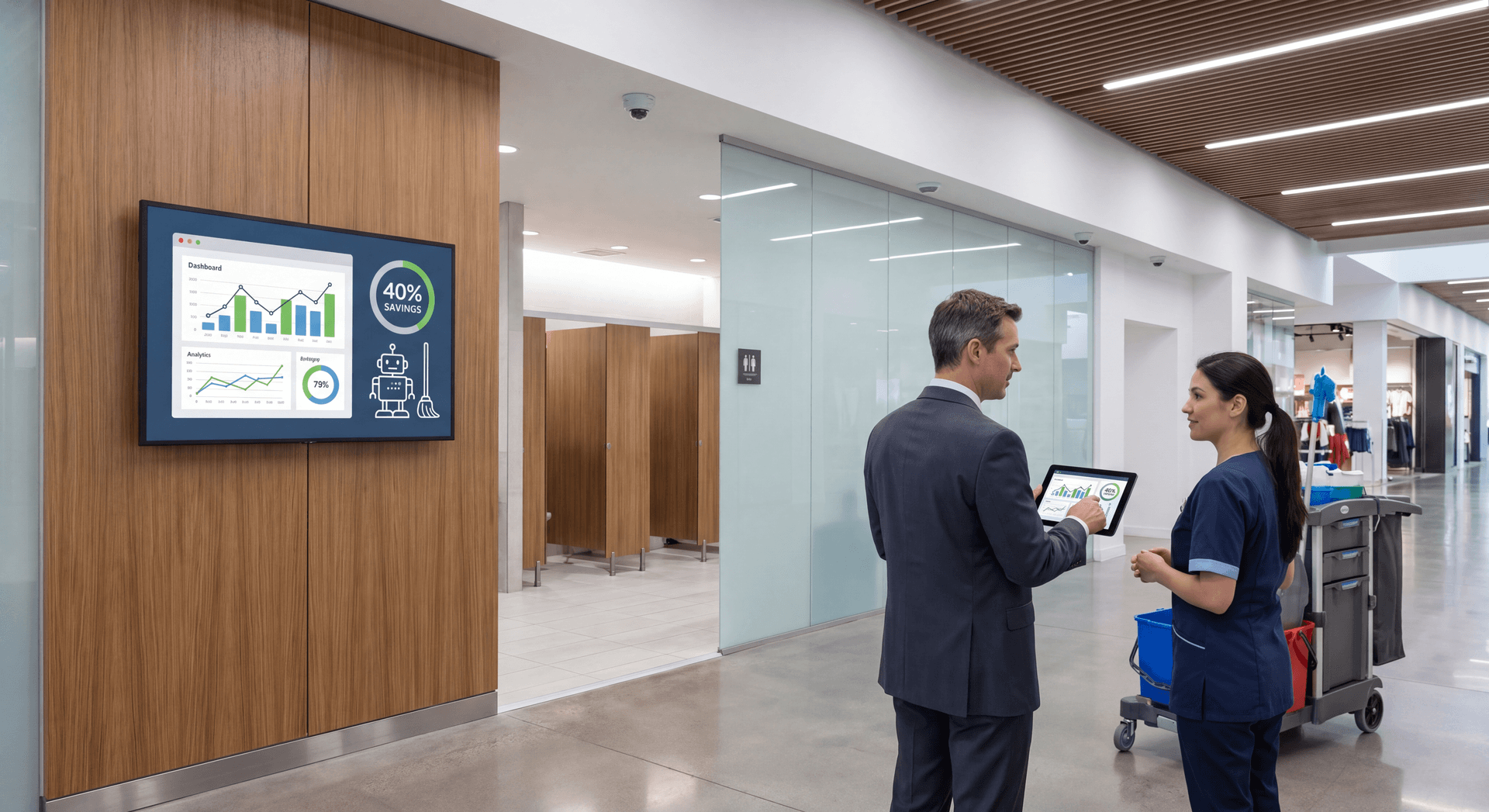
- Restroom monitoring: Occupancy sensors and supply level monitoring address top tenant complaints while reducing unnecessary cleaning visits by 30-40%
- HVAC optimization: Smart thermostats and zone controls deliver immediate energy savings of 10-15%
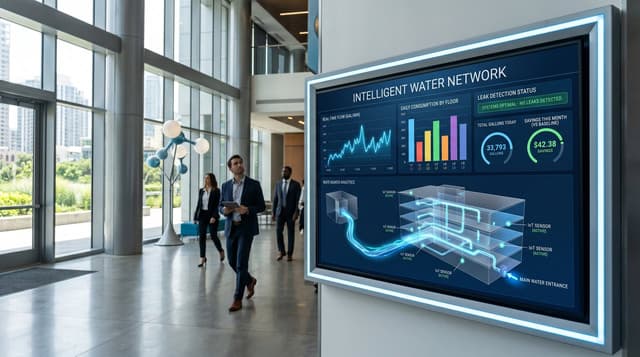
- Leak detection: Water sensors in mechanical rooms and near plumbing prevent water damage averaging $7,000 per incident
Phase 2: Integration (3-9 Months)
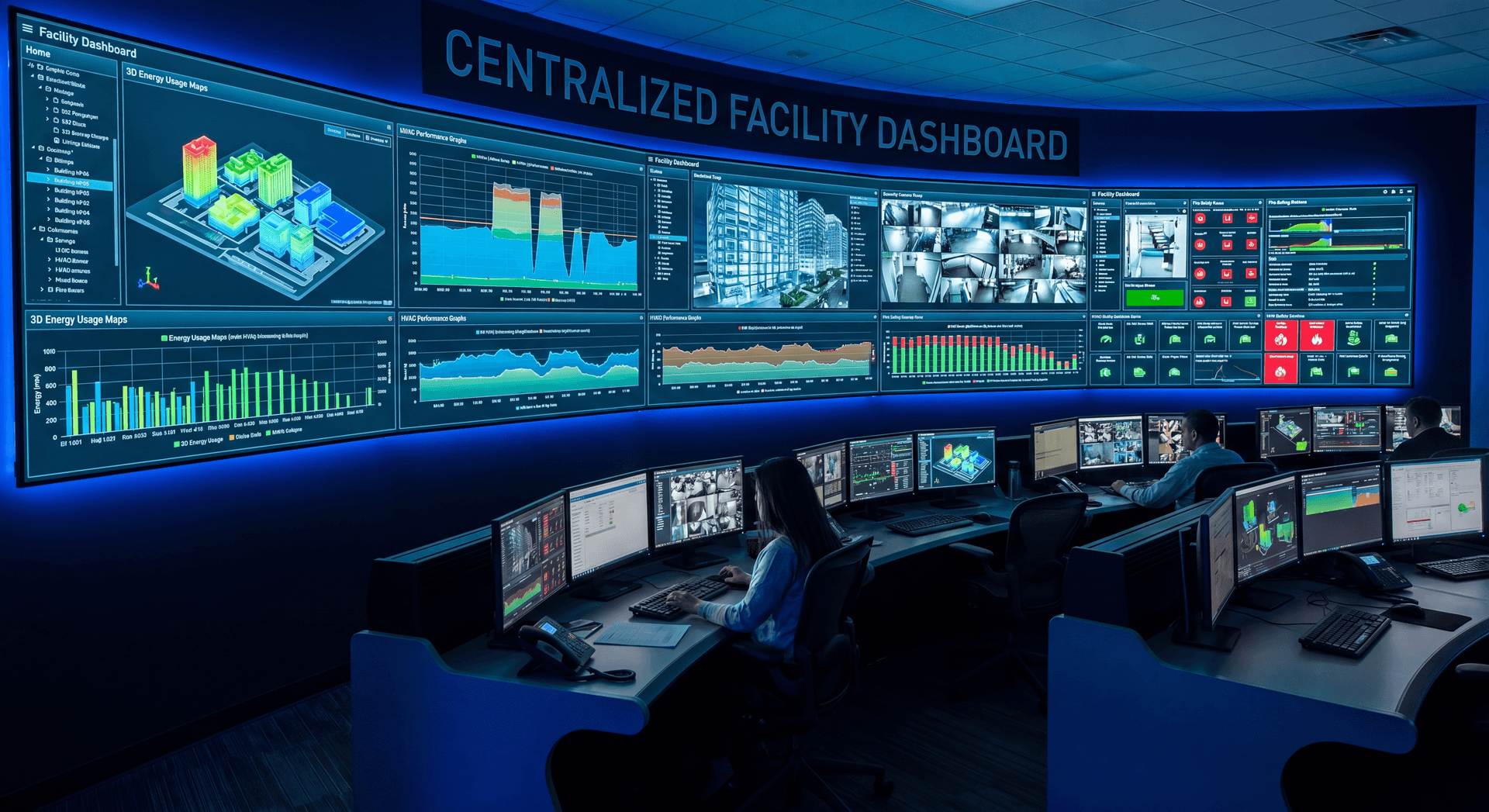
Connect systems to centralized dashboard and establish baseline metrics:
- Integrate sensor data with building management systems
- Train facility teams on platform utilization
- Establish KPI dashboards for ongoing monitoring
- Begin predictive maintenance protocols
Phase 3: Optimization (9-18 Months)
Leverage accumulated data for advanced optimization:
- Refine preventive maintenance schedules based on actual equipment performance
- Implement AI-driven energy optimization
- Extend monitoring to additional building systems
- Document and report ROI metrics to stakeholders
Key Performance Indicators for Building Owners
Track these metrics to measure smart facility management success:
| KPI | Target Improvement | Measurement Frequency |
| Work order response time | 30-40% reduction | Weekly |
| First-time fix rate | 20-30% improvement | Monthly |
| Energy use intensity (EUI) | 10-20% reduction | Monthly |
| Preventive vs. reactive maintenance ratio | 70:30 or better | Monthly |
| Tenant satisfaction score | 15-25% improvement | Quarterly |
| Equipment uptime | 98%+ | Monthly |
Addressing Common Concerns
"What about cybersecurity risks?"
IoT devices require robust security protocols. Work with vendors who provide end-to-end encryption, regular firmware updates, and network segmentation. The National Institute of Standards and Technology (NIST) provides cybersecurity frameworks specifically for IoT deployments in commercial buildings.
"Will this replace our facility management team?"
Smart technology augments rather than replaces facility teams. Buildings still require skilled technicians for repairs and tenant interactions. The technology eliminates wasted effort—unnecessary inspections, redundant trips, and guesswork—allowing teams to focus on high-value activities.
"What if our building has older systems?"
Retrofit-friendly sensors and non-invasive monitoring solutions work with existing infrastructure. Many building owners begin with wireless sensors that don't require system integration, then progressively connect to legacy building automation systems as budgets allow.
Frequently Asked Questions
What is the minimum building size for smart facility management ROI?
Smart facility management delivers positive ROI for buildings as small as 25,000 square feet. However, economies of scale improve returns for larger buildings and portfolios. Multi-building deployments can share platform costs, reducing per-building technology investment by 15-25%.
How long does implementation typically take?
Basic sensor deployments for high-impact areas (restrooms, HVAC zones, leak-prone locations) can be completed in 2-4 weeks. Comprehensive building-wide implementations typically require 3-6 months, including integration with existing systems and staff training.
What is the typical payback period for smart facility management?
Most building owners achieve positive ROI within 18-24 months. Buildings with higher baseline operating costs (older equipment, energy-inefficient systems, high tenant turnover) often reach payback in 12-15 months due to larger absolute savings.
Do smart building systems require dedicated IT support?
Modern cloud-based platforms minimize IT requirements. Most solutions are managed by the vendor, requiring only reliable internet connectivity. Building owners without dedicated IT staff can typically manage systems with 2-4 hours of monthly oversight.
Can smart facility management improve building valuations?
Yes. Buildings with documented operational efficiency and smart building certifications often command 5-15% higher valuations. Additionally, smart building systems generate the operational data required for Environmental, Social, and Governance (ESG) reporting that increasingly influences investor decisions.
Conclusion
Smart facility management delivers measurable, documented returns for building owners willing to invest in connected technology. With average operating cost reductions of 15-30%, payback periods under three years, and additional benefits including improved tenant satisfaction and enhanced building valuations, the business case is compelling.
The transition from reactive to proactive facility management represents a fundamental shift in how buildings operate. Building owners who implement smart monitoring systems today position their properties for competitive advantage in an increasingly technology-driven real estate market.
Next Steps: Assess your building's current operating costs across energy, maintenance, and tenant turnover categories. Request demonstrations from smart facility management providers serving your building type. Start with high-impact pilot deployments to build organizational confidence before broader implementation.
For more information on smart facility management solutions, visit LBS Smarttech.
Sources: Jones Lang LaSalle (JLL) 2024 Global Real Estate Technology Survey; U.S. Department of Energy, Operations & Maintenance Best Practices Guide; U.S. EPA ENERGY STAR Building Upgrade Manual; Building Owners and Managers Association (BOMA) International 2024 Technology Guide; National Institute of Standards and Technology (NIST) Cybersecurity for IoT Program.
Schema Markup (JSON-LD)
{
  "@context": "https://schema.org",
  "@type": "Article",
  "headline": "The ROI of Smart Facility Management: What Building Owners Need to Know",
  "description": "Discover how smart facility management delivers measurable ROI through IoT sensors, predictive maintenance, and real-time monitoring.",
  "author": {
    "@type": "Organization",
    "name": "LBS Smarttech",
    "url": "https://lbs-smarttech.com/"
  },
  "publisher": {
    "@type": "Organization",
    "name": "LBS Smarttech",
    "url": "https://lbs-smarttech.com/"
  },
  "datePublished": "2026-03-27",
  "dateModified": "2026-03-27",
  "mainEntityOfPage": {
    "@type": "WebPage"
  }
}
{
  "@context": "https://schema.org",
  "@type": "FAQPage",
  "mainEntity": [
    {
      "@type": "Question",
      "name": "What is the minimum building size for smart facility management ROI?",
      "acceptedAnswer": {
        "@type": "Answer",
        "text": "Smart facility management delivers positive ROI for buildings as small as 25,000 square feet. Multi-building deployments can share platform costs, reducing per-building technology investment by 15-25%."
      }
    },
    {
      "@type": "Question",
      "name": "How long does implementation typically take?",
      "acceptedAnswer": {
        "@type": "Answer",
        "text": "Basic sensor deployments for high-impact areas can be completed in 2-4 weeks. Comprehensive building-wide implementations typically require 3-6 months, including integration with existing systems and staff training."
      }
    },
    {
      "@type": "Question",
      "name": "What is the typical payback period for smart facility management?",
      "acceptedAnswer": {
        "@type": "Answer",
        "text": "Most building owners achieve positive ROI within 18-24 months. Buildings with higher baseline operating costs often reach payback in 12-15 months due to larger absolute savings."
      }
    },
    {
      "@type": "Question",
      "name": "Do smart building systems require dedicated IT support?",
      "acceptedAnswer": {
        "@type": "Answer",
        "text": "Modern cloud-based platforms minimize IT requirements. Most solutions are vendor-managed, requiring only reliable internet connectivity and 2-4 hours of monthly oversight."
      }
    },
    {
      "@type": "Question",
      "name": "Can smart facility management improve building valuations?",
      "acceptedAnswer": {
        "@type": "Answer",
        "text": "Yes. Buildings with documented operational efficiency and smart building certifications often command 5-15% higher valuations. Smart building systems also generate data for ESG reporting that influences investor decisions."
      }
    }
  ]
}